Translated with AI from the Russian original.
Solar activity has intensified again. Scientists warned that a new strong flare could occur on May 13 in one of the most active regions on the star's surface. This was reported by the Laboratory of Solar Astronomy of IKI RAS and ISZF SB RAS.
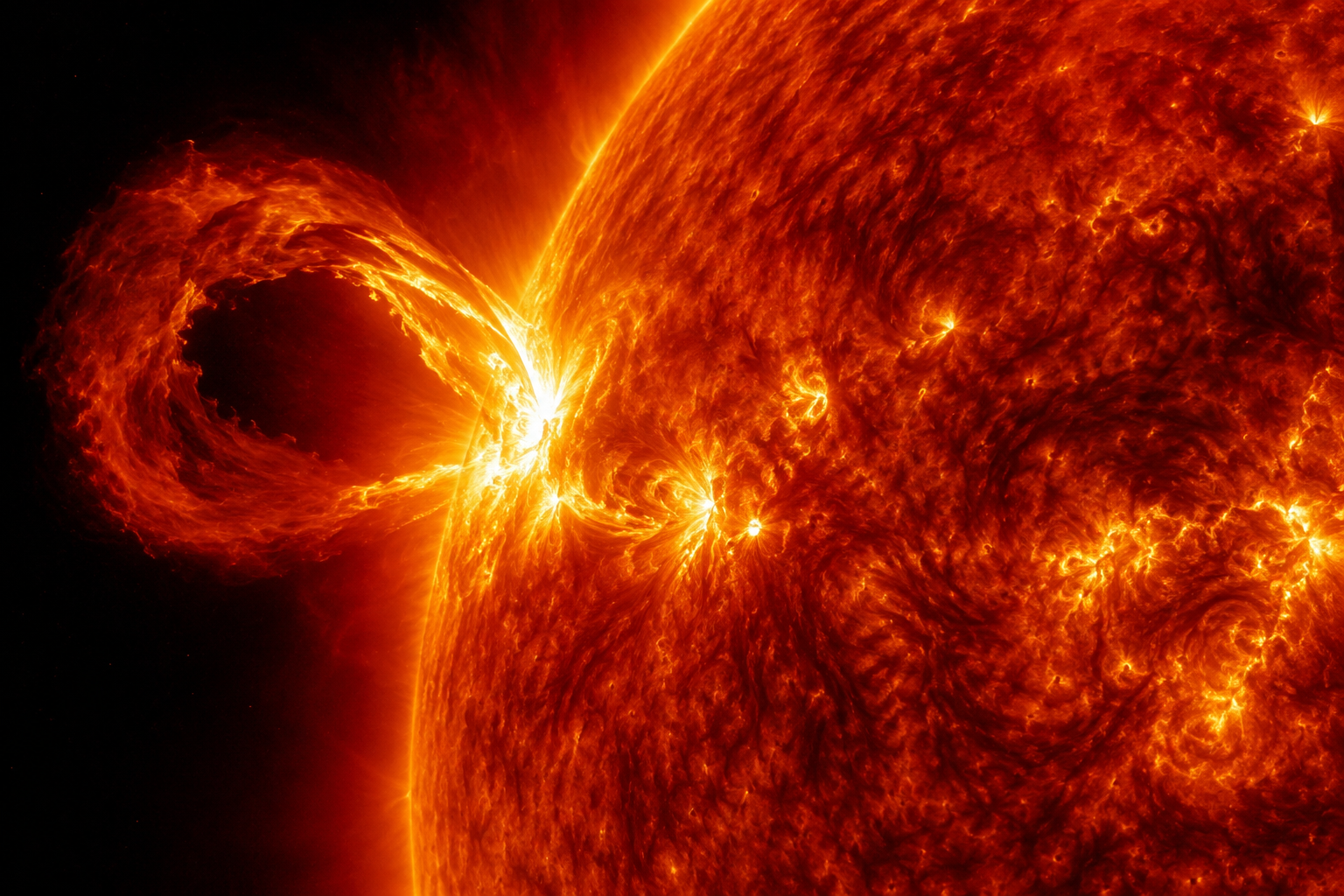
Earlier, on May 10, the Institute of Applied Geophysics reported an M5.8 class flare that lasted 37 minutes. It occurred in sunspot group 4436.
According to experts, if this sunspot group needs about three days to accumulate new energy, then the next strong flare can be expected as early as Wednesday, May 13. Scientists note that two powerful explosions have already occurred in a row in this active center.
The previous M2.6 class flare was recorded on May 7. It was accompanied by a plasma ejection. The new flare on May 10 also led to the ejection of a plasma cloud.
Specialists analyzed data from LASCO C2 and C3 solar telescopes, as well as the movement of the plasma cloud. According to their assessment, the ejection passes by Earth with a large margin and moves away from the planet.
However, by May 13, the active region on the Sun will shift closer to the central part of the solar disk and will be in the zone of influence on Earth.
Magnetic storms on Earth occur precisely after powerful solar flares and plasma ejections. During such events, the Sun ejects huge clouds of charged particles into space. If this stream is directed towards Earth, it collides with the planet's magnetic field. As a result, magnetic storms can occur, which sometimes affect radio communications, satellites, navigation, and the well-being of weather-sensitive people.
Magnetic storms on Earth occur after powerful solar flares and plasma ejections. During such events, the Sun ejects huge clouds of charged particles into space. If this stream is directed towards Earth, it collides with the planet's magnetic field.
Magnetic storms sometimes affect radio communications, satellites, navigation, and the well-being of weather-sensitive people. In addition, they cause auroras.
Read more on the topic:
Never miss our newsAdd this site to your preferred sources to see us more oftenAdd on Google

















