A Russian device will be installed on the International Space Station (ISS) to help understand how solar flares occur and how to predict them. According to the P. N. Lebedev Physical Institute of the Russian Academy of Sciences, the "Solntse-Teragerts" (Sun-Terahertz) apparatus has already passed all tests aboard the ISS and is being prepared for external mounting on the station.
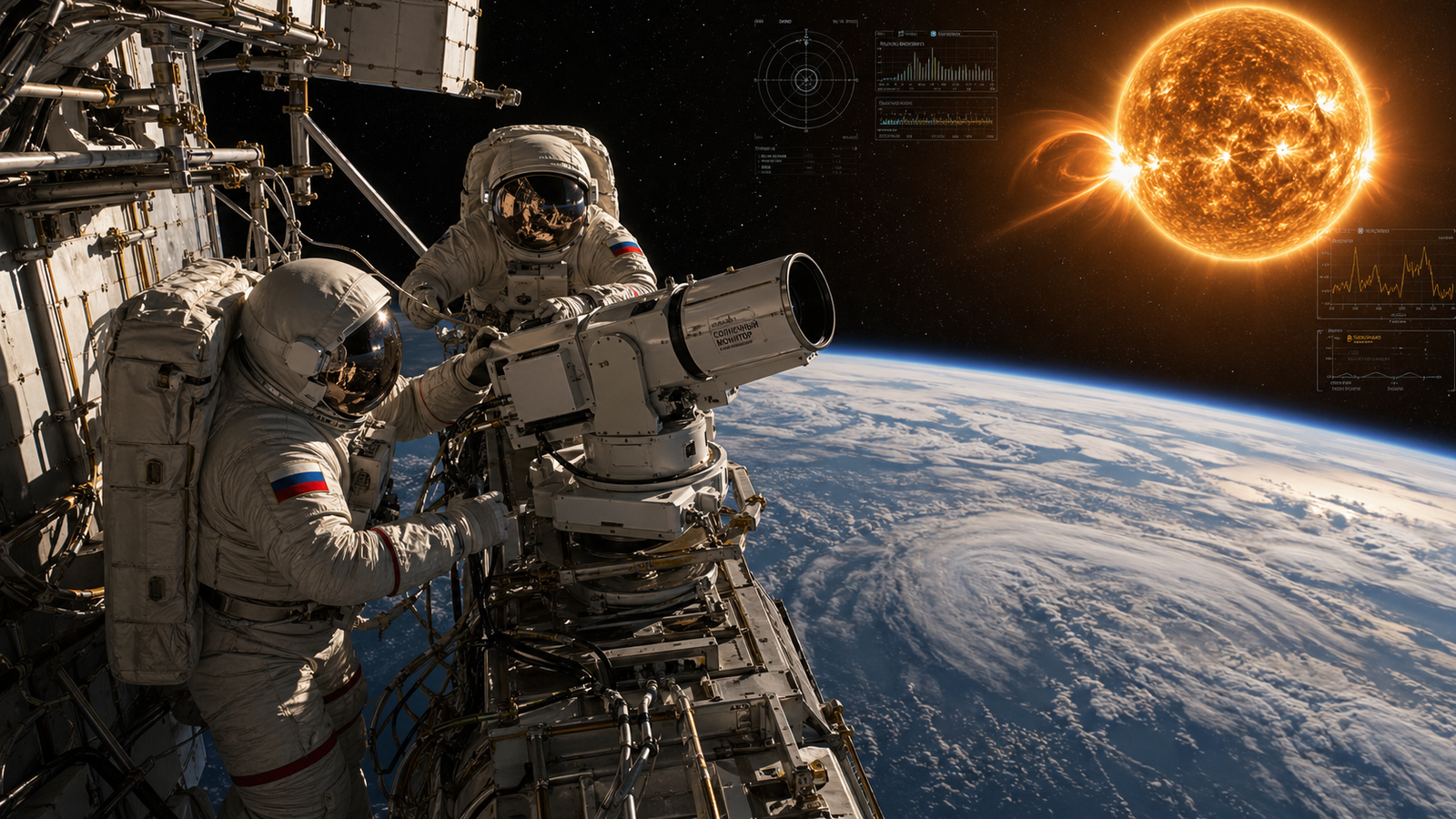
Russian cosmonauts tested the equipment inside the station using special software developed at FIAN. After that, communication cables were laid, connecting the onboard computer to a two-axis pointing platform. The device will be installed on this platform.
The platform will allow it to constantly remain pointed at the Sun during the daytime portion of the ISS orbit.
The installation of "Solntse-Teragerts" is scheduled for May 27. The work will take place during a spacewalk involving cosmonauts Sergey Kud-Sverchkov, Sergey Mikaev, and Andrey Fedyayev.
The device weighs 47 kilograms and consists of eight detector channels, each tuned to its own frequency range. In total, it will be able to detect radiation in the range from 0.4 to 12 terahertz.
The equipment will allow observation of the Sun in the terahertz range and investigation of the processes underlying solar flares.
Read more on the topic:
Never miss our newsAdd this site to your preferred sources to see us more oftenAdd on Google

















