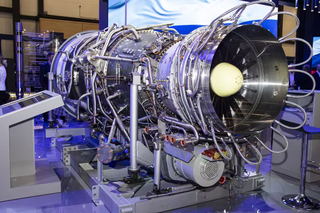
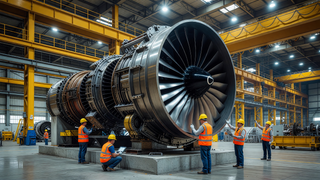
A laser shock peening technology for titanium and heat-resistant alloys has been developed in Russia. The development, carried out by engineers from the Moscow Aviation Institute in collaboration with specialists from the P.I. Baranov Central Institute of Aviation Motors, the Research Institute of Engine Technology and Production Organization, the A.M. Lyulka Design Bureau, and ODK-Aviadvigatel, forms a protective layer up to 1.5 millimeters deep on parts — approximately five times thicker than with traditional shot peening, where the surface is bombarded with metal balls to create work hardening. The first serial complex is planned to be commissioned in 2027 and will form the basis for the production of new generation aircraft engines.
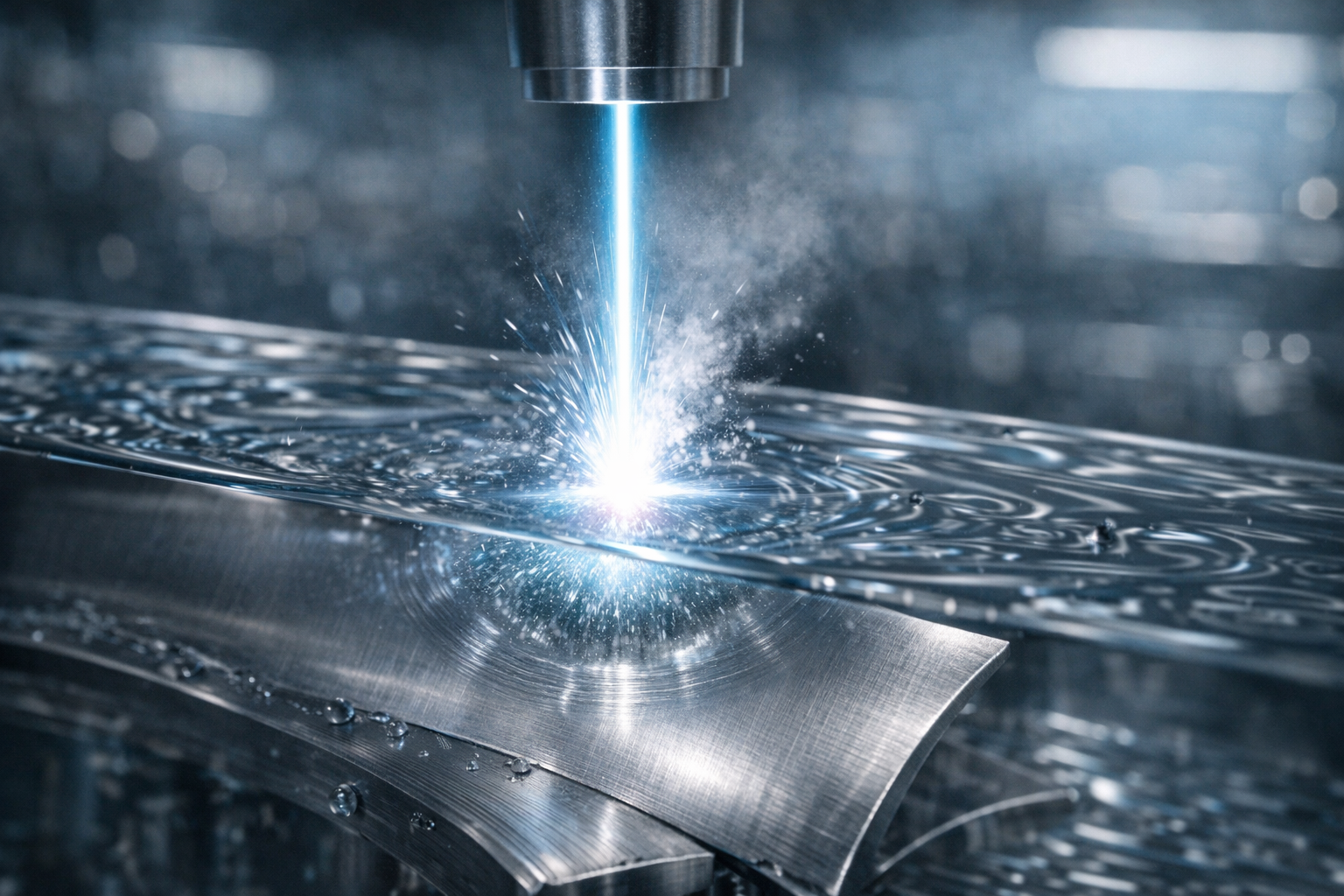
The method uses powerful laser pulses that strike through a layer of water. Micro-explosions deform the metal surface without heating, creating compressive stresses in the surface layer — the metal is as if compressed, and it is more difficult for microcracks to open and grow. Shot peening provides a hardened layer of only up to 0.3 millimeters. The laser allows the protection to be deepened to 1.5 millimeters.
To destroy a part, a crack must pass this 1.5 mm barrier. This means, for example, a compressor blade that has already sustained a micro-tear from dust or a stone can safely operate for thousands more cycles.
However, this technology is not a panacea. Evgeny Vishnevsky, an expert of the National Technology Initiative for new materials and technologies, described the development as a “surgical scalpel” for the most stressed areas — blades, disks, shafts, gears, and chassis elements. Each laser pulse processes only a small spot, so in terms of productivity, the method is many times inferior to shot peening and is not suitable for conveyor production. Precise positioning and parameter selection for each alloy are required, there is a risk of local metal destruction on sharp edges, and future certification will require non-destructive testing equipment — ultrasonic or X-ray flaw detection, capable of looking inside the metal to the full depth of the hardened layer. This will increase the cost of the process by an order of magnitude — acceptable for the aviation industry, but not for mass automotive production.
Read more on the topic:
Never miss our newsAdd this site to your preferred sources to see us more oftenAdd on Google