The ring of fire around the Moon eclipsing the Sun will be so bright that it will not allow seeing the stars closest to them during the eclipse on February 17, the Moscow Planetarium told TASS.
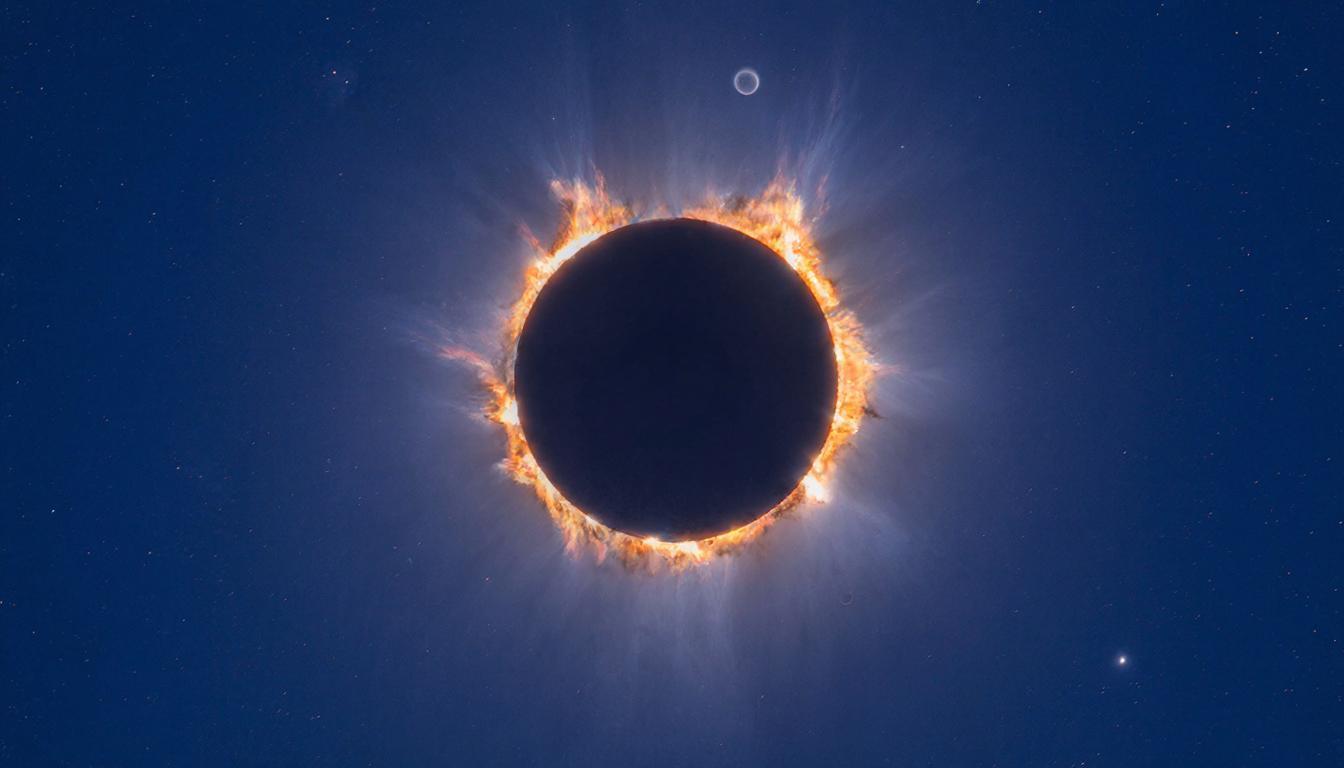
The peak of the eclipse will occur at 15:13 Moscow time - the maximum phase will be 0.963 and will last 2 minutes 19 seconds. The phenomenon as a whole will take 4.5 hours.
If the Moon covers only part of the solar disk, the eclipse is called partial. If the entire disk is hidden, it is called total. If its central part is closed, leaving a ring, it is called annular. During an annular eclipse, the bright rim of the Sun does not allow seeing either the corona or the stars near the Sun.
The event will not be seen in Russia. The annular phase will be observed in Antarctica and over the Atlantic, partial phases in South America and Africa. The Sun and Moon will be in the constellation Aquarius during the eclipse.
Earlier, Vitaly Frantsev, a lecturer at the Moscow Planetarium, explained that the "ring of fire" appears when the Moon passes between the Earth and the Sun near the apogee - the farthest point of its orbit. At this moment, the visible diameter of the satellite is smaller than the solar diameter, so it does not completely cover the Sun, leaving a shining rim. If the Moon is at perigee (closer to Earth), a total eclipse occurs.
Read more materials on the topic:
- Roscosmos Tu-204-300 aircraft climbed 10 km to observe the lunar eclipse
- The Sun "froze": a powerful burst of activity suddenly stopped
- The Sun absorbed the largest cluster of spots
Never miss our newsAdd this site to your preferred sources to see us more oftenAdd on Google