The "Gaskar" company has announced a new version of the "Nebo-22" VR simulator, designed for training and advanced training of unmanned aerial vehicle (UAV) operators. The updates have increased the functionality of the system. It has become a universal tool for individual, group, and engineering training, as well as for the implementation of complex UAV usage scenarios.
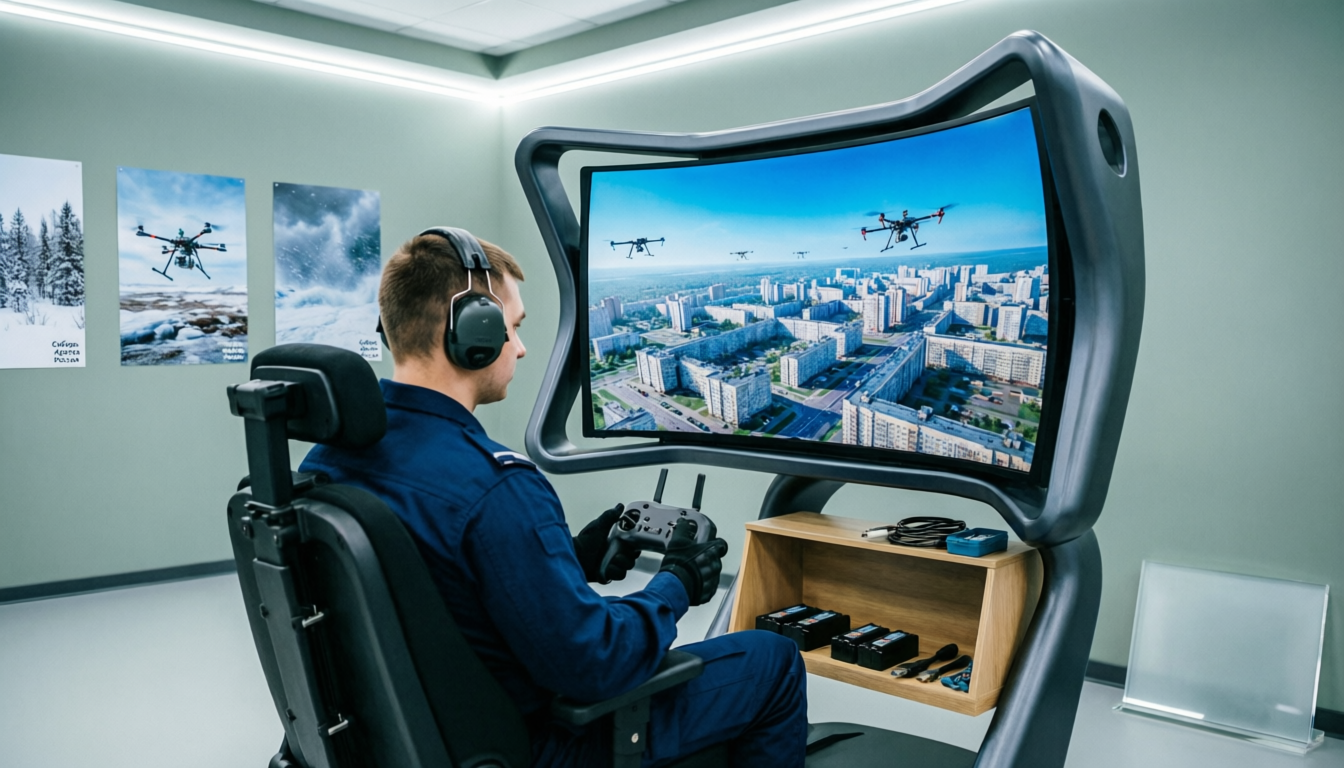
"Nebo-22" is suitable for users with any level of training — from beginners to experienced professionals. The system consists of 25 training modules that allow you to work through theory and practice, offering tasks simulated based on the real experience of drone operators.
An important innovation has appeared in the updated version of "Nebo-22": the set of functions for performing missions has been expanded. The system now offers new scenarios for FPV drones, fixed-wing UAVs, and unmanned crews. They cover maneuvering, fire adjustment, visual tracking, electronic warfare countermeasures, and other tasks, including complete cycles of preparation and execution of flight missions.
The system actively supports group training. With its help, you can train several operators simultaneously in one virtual space, monitor actions and analyze the execution of tasks, including the interaction of various types of UAVs.
The "Nebo-22" simulator highly effectively simulates the operation of the main onboard systems of UAVs, including cameras and navigation equipment. The use of real topographic data helps to create an atmosphere of different climatic, temporal, and landscape conditions. Users can measure distances and heights, work with points and tracks, which contributes to a more accurate correspondence of virtual models to real UAVs.
The "Nebo-22" complex covers more than 20 models of unmanned aerial vehicles. User training is carried out on the client's side, and equipment warranties are specified for one year. The product is in the certification stage.
Read more materials on the topic:
- Hybrid engine with a capacity of 500 kW for drones created in Russia
- Tomsk scientists have created a compact rotary piston engine for drones with a capacity of 36 hp
- A VR simulator for training operators of "wing"-type drones has been created in Rostov
Never miss our newsAdd this site to your preferred sources to see us more oftenAdd on Google




![Growth Point: After 5G Launch, Mobile Internet in Russia Accelerated by 20%","subtitle":"TelecomDaily recorded an upload speed increase of 19.7%, and download speed of almost 14%","announce":""}[]}],](https://media.ixbt.site/fit-in/320x/ixbt-data/1727896/ai-image-nvgq0a0v5cjnyxwoc8xpelva.webp)