Scientists from the NUST MISIS and the Russian Quantum Center have developed a new approach to performing a three-qubit operation on superconducting qubits - fluxoniums. This project has already been supported by Rosatom as part of the Roadmap for Quantum Computing.
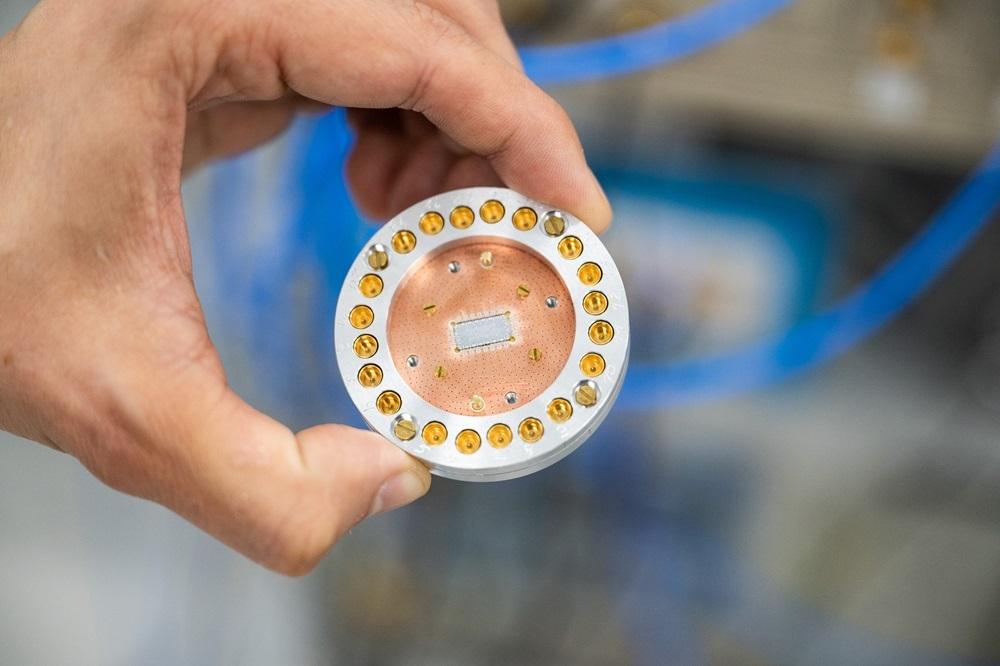
As explained in the press service of NUST MISIS, the implementation of a multi-qubit entangled state is one of the most important tasks for quantum computing. Entanglement allows extracting useful information from the calculation of a function at several points, which is allowed by superposition.
Most modern quantum processors use two-qubit quantum operations, but errors occur during their implementation. Three-qubit operations can perform a larger range of algorithms in fewer steps, and they have fewer errors.
They are performed on a new type of superconducting qubits - fluxoniums. Fluxoniums significantly outperform the most common qubits - transmons - in terms of isolation of computational states, coherence time, and other significant indicators. The connecting element is a transmon qubit, but more resistant to technological errors.
The main advantage of this approach is the execution of the operation using a microwave pulse applied to the connecting element. The very presence of the connecting element significantly reduces the unwanted interaction of qubits, and activation by a microwave pulse allows for an effective three-qubit interaction without taking the qubits out of the points most protected from external noise.
Quantum processors with a three-qubit operation can potentially be used to create a "noisy" quantum processor and algorithms for effective multi-qubit operations. Quantum effects are useful for studying molecules, creating medicines, effectively solving logistics problems, and searching in a database.
Read materials on the topic:
Rosatom has developed a 20-qubit quantum computer, but does not yet know its area of application
Never miss our newsAdd this site to your preferred sources to see us more oftenAdd on Google

















