Translated with AI from the Russian original.
Scientists from Saint Petersburg Electrotechnical University "LETI" and the Saint Petersburg Institute of History of the Russian Academy of Sciences have successfully restored completely lost and partially erased records on ancient parchment documents from the 14th-15th centuries. To achieve this, specialists used modern optical methods that allow studying fragile manuscripts without damage.
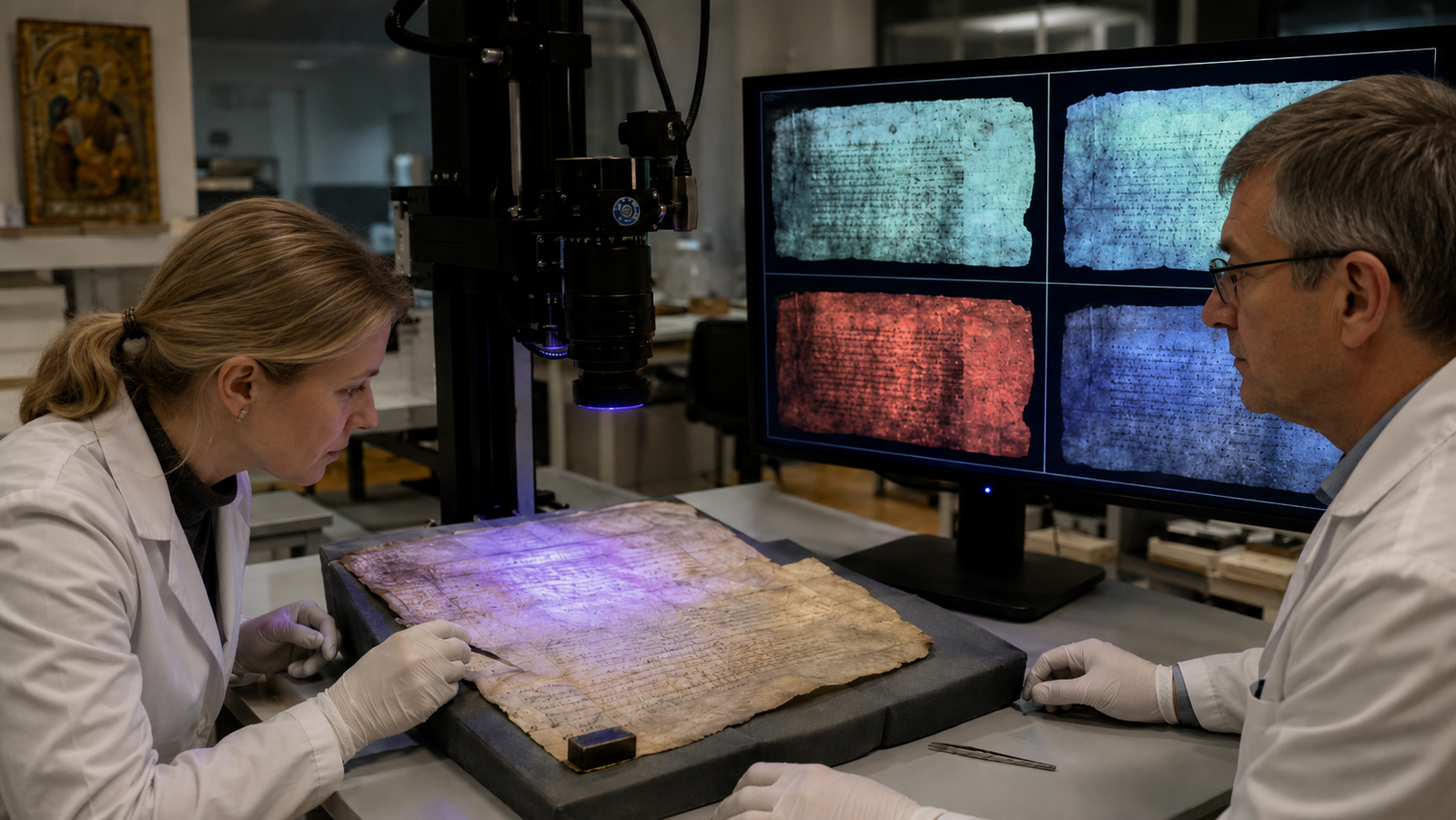
The objects of study were messages from Venetian Doges – official diplomatic and administrative documents of the Renaissance era. Over time, organic ink on parchment faded, and some records were intentionally removed, making these historical sources difficult to study.
The scientists applied several technologies: digital photography under ultraviolet illumination, hyperspectral imaging, and a special detector for preliminary searching for hidden records. UV imaging proved to be the most effective, allowing them to see completely vanished inscriptions.
In addition, specialists used infrared Fourier spectroscopy without taking samples. This method helped to study the condition of the parchment and determine the composition of dark spots of unknown origin on one of the documents.
A separate study was conducted on a charter from 1360. Scientists found that the mysterious spots on its surface appeared due to traces of microorganisms' vital activity, which got onto the parchment along with insect larvae during the document's storage in the Treviso archive.
Inscriptions on the reverse side of ten letters from Venetian Doges, addressed to the Podestà and captains of Treviso, were successfully deciphered. Researchers established that all these marks were made by the same hand in the 16th-17th centuries. The restored inscriptions contained information important for studying the legal practice and history of the city of Treviso.
Scientists suggest that some records might have been damaged during an archive review when documents received new markings on paper fragments glued over old records. There is also a theory that archival marks might have been removed in the 19th century when the documents entered the antique market, to conceal their origin.
In the future, scientists plan to use infrared spectroscopy and mathematical analysis to identify the types of microorganisms that damage historical documents.
Read more on the topic:
Never miss our newsAdd this site to your preferred sources to see us more oftenAdd on Google

















