Translated with AI from the Russian original.
In Tomsk, the first line in Russia for heating remote villages using "combustible ice" has begun to be assembled. This is the name given to gas hydrates – gas compounds in an ice and water shell. When heated, they release gas, which can be immediately used for heating homes and domestic needs. The development is being created at the Tomsk Polytechnic University site.
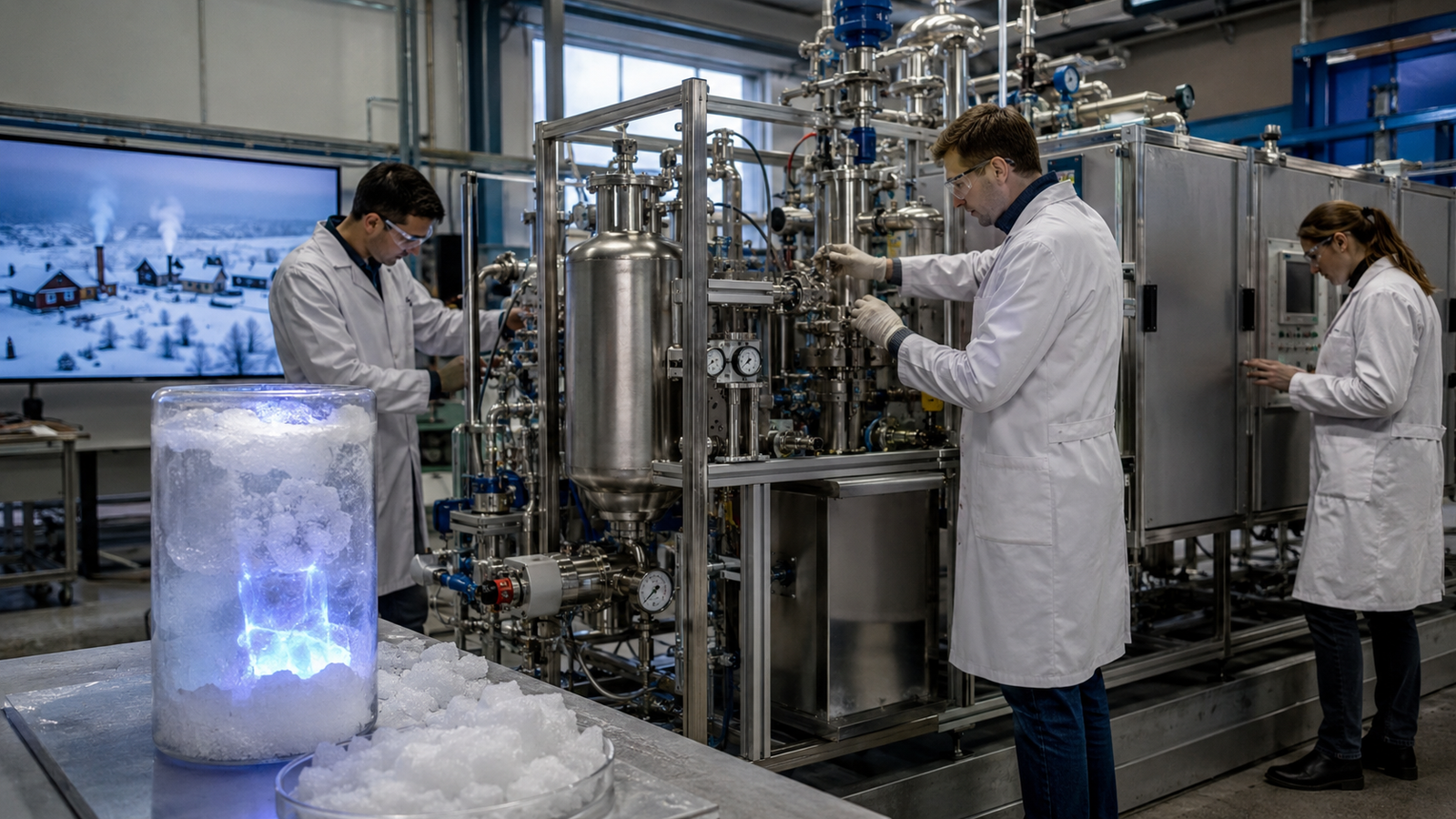
The installation for generating "combustible ice" has no analogues in Russia and the world, said Nikita Shlegel, acting head of the TPU Youth Laboratory of Gas Hydrates. This is especially important for remote settlements: the new solution allows avoiding the laying of gas pipelines and the construction of additional infrastructure.
Gas hydrates are called the frozen fuel of the future. In nature, they are extracted from the bottom of seas and oceans, and this is the richest source of hydrocarbon gas on the planet. When burned, this fuel produces minimal anthropogenic emissions into the atmosphere compared to coal, fuel oil, and petroleum products. But there is still no established technology for its use in everyday life and industry.
The TPU complex will operate in three stages. First, the gas will be prepared for use: this can be natural, associated, landfill, or mine gas. Then, in a 200-liter reactor, gas hydrates will be synthesized from it and transferred to a transport container – a "hydrate battery." After that, the system will simulate the delivery and use of fuel for three options: a private house with a boiler, an industrial enterprise with a compressor station, and an enterprise with a gas piston power plant.
In 6–8 hours, such a line will be able to produce about 200 liters of hydrate, which corresponds to approximately 32 thousand cubic meters of gas. This volume is enough to heat a small village of 50 houses for a month in winter. Scientists will be able to remotely control the installation and monitor its parameters.
In the future, the complex will be supplemented with another reactor – for synthesizing hydrates from carbon dioxide. They are planned to be used in research on hydrate fire extinguishers and bombs for extinguishing fires.
After testing and refining the technology, scientists, together with an industrial partner, intend to develop and certify a mobile line. In 2027, it is planned to be sent to a field in the Republic of Sakha (Yakutia), where it will be used to heat a village.
Read more on the topic:
- New Generation Heating Systems: Tomsk Scientists' Development Will Improve Climate Control and Fire Safety in Buildings
- The energy of the future: The National Center for Physics and Mathematics is looking for new energy sources in the microcosm
- Electricity to be generated directly from groundwater: Russian scientists propose an unusual generator
Never miss our newsAdd this site to your preferred sources to see us more oftenAdd on Google

















