Russian scientists have proposed generating electricity from the movement of groundwater. Specialists from Novosibirsk State Technical University NETI have developed a generator scheme that converts water energy into electrical voltage. Such a source can be useful for powering sensors, geophysical instruments, and other equipment during operations in hard-to-reach areas.
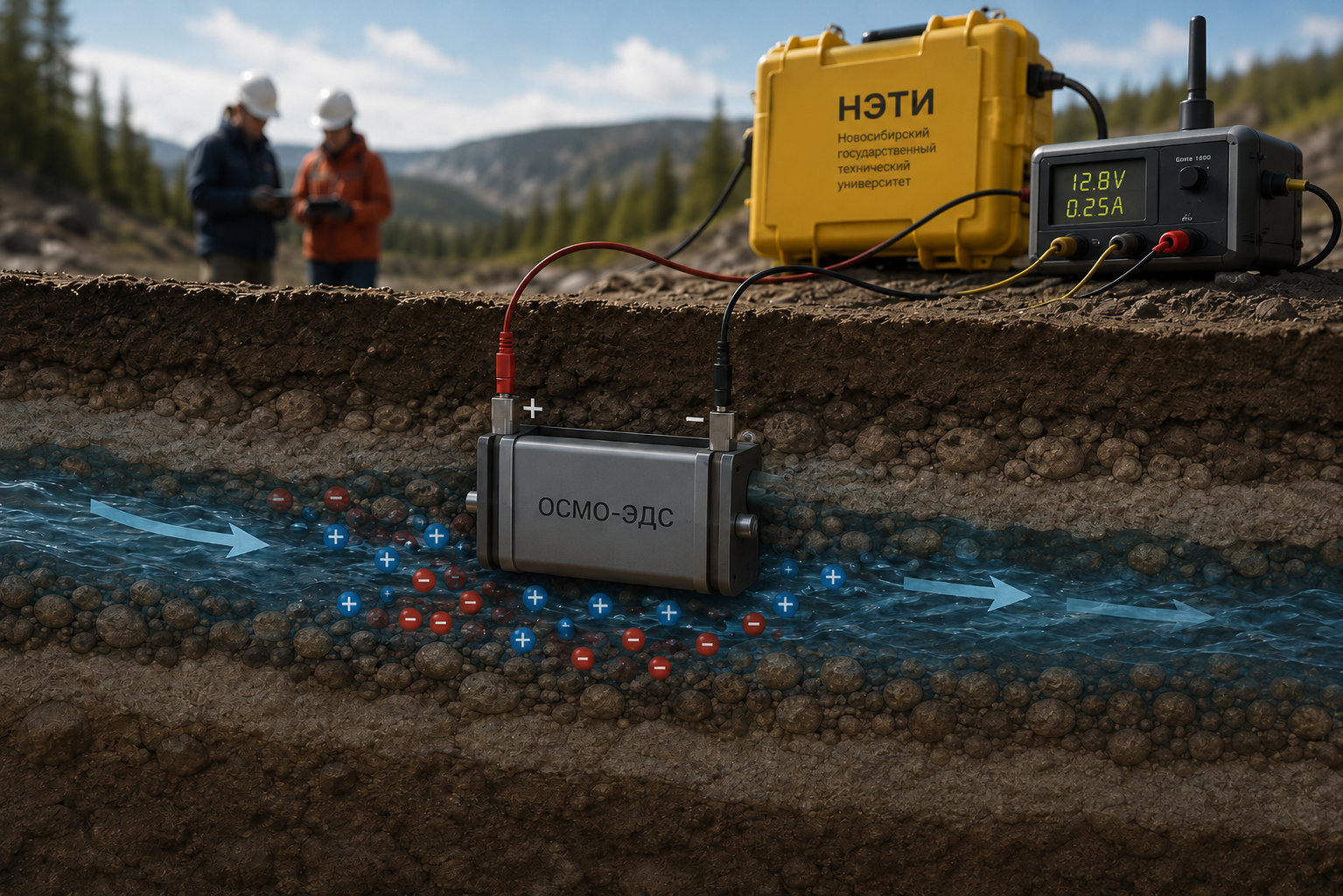
For geological exploration, this technology is especially important because in field conditions it is not always possible to connect to the power grid or regularly charge batteries. Therefore, scientists proposed using the energy of groundwater movement through porous rocks. When water passes through the soil, it carries away some of the charged particles, while others remain on the rock surface. Due to the separation of charges, an electrical voltage arises.
To understand how much energy can be obtained in this way, specialists study the properties of the soil: how easily water passes through it, what is the charge of its surface, and how particles behave inside the rock. Water saturation is especially important: the more water in loose soil, the better the conditions for the appearance of the desired electrical effect.
The generator itself is relatively simple. Electrodes are placed in porous soil at different heights, and groundwater moves between them under its own pressure. As a result, a voltage arises between the electrodes, which can be used for autonomous power supply of geophysical instruments and sensors during field work.
Read more on the topic:
Never miss our newsAdd this site to your preferred sources to see us more oftenAdd on Google