Translated with AI from the Russian original.
Scientists from Perm Polytechnic University have developed a method to protect landfills and waste sites from leaks of toxic liquid into the soil and groundwater. The new system monitors the evenness of the underground protective wall during construction and allows problematic areas to be immediately sealed with additional cement. Previously, such defects were only discovered after one or two months, when the solution had already fully hardened.
The main danger of landfills is leachate. This is a toxic liquid that forms when rain and melted snow pass through layers of waste. Water washes mercury, lead, cadmium, salts, acids, benzopyrene, bacteria, and other dangerous substances from the waste.
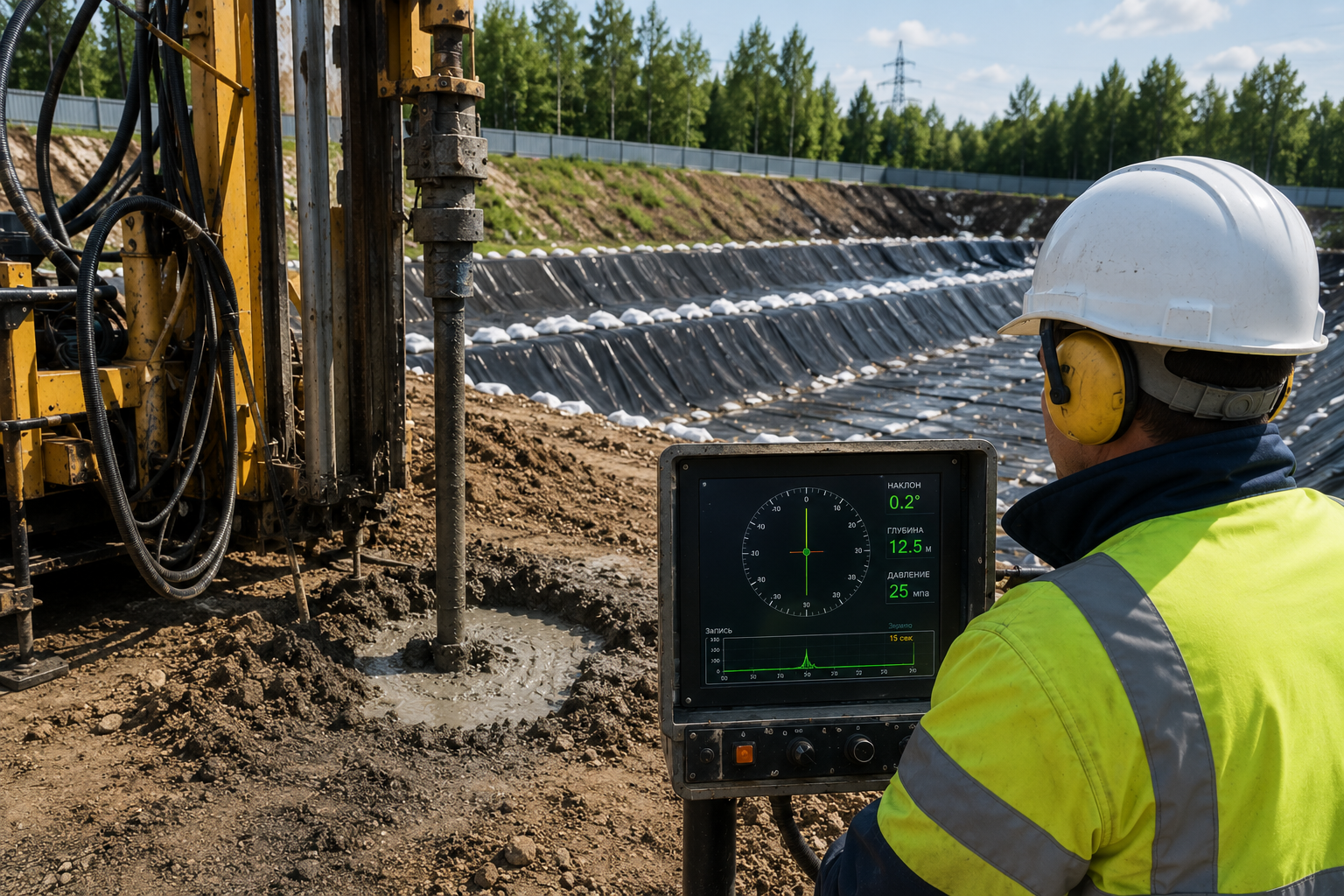
For old landfills and unequipped waste sites, an underground cement wall is built around the area. Wells are drilled into the ground, and a solution is poured under pressure, which mixes with the soil and forms individual piles after hardening. The most vulnerable spots are the joints between them. If the drill deviates, the piles will not connect, and a gap will remain between them, through which toxins can pass.
Previously, the quality of the wall was checked only after the cement had hardened – after 28–60 days. For this, ultrasound was used, or samples were drilled out of the finished structure. The first method did not allow for a full check of the joints, and the second was expensive and damaged the wall. If a defect was still found, the area had to be re-drilled and cemented, which required additional money, materials, and weeks of work.
Scientists integrated an inclinometer into the drilling rig – a sensor that measures the inclination of the well with an accuracy of one-tenth of a degree. The operator receives data every 15 seconds and immediately sees if the drill has deviated. During the tool's ascent, he can supply more cement and close the gap before the solution hardens. The sensor is protected from vibration, high temperature, and pressure of hundreds of atmospheres by a special casing and valve.
The system's operability was confirmed on an experimental section of an anti-filtration barrier. Scientists believe that the method can be applied to old landfills in various regions of Russia and isolate toxic liquid for decades. A patent has already been obtained for the invention.
According to the Ministry of Natural Resources, there are about 900 official municipal solid waste landfills operating in Russia, and Rosprirodnadzor identifies almost 8.7 thousand illegal dumps. Every year, about 400 thousand hectares of land are allocated for new waste sites.
Read more on the topic:
Never miss our newsAdd this site to your preferred sources to see us more oftenAdd on Google

















