Translated with AI from the Russian original.
The Ministry of Industry and Trade is launching two projects to import-substitute equipment for epitaxy – the process of growing layers of silicon and gallium arsenide for chip production, CNews reports. The developments are intended to replace installations from American Veeco, French Riber, and Dutch ASM, whose deliveries to Russia have been blocked.
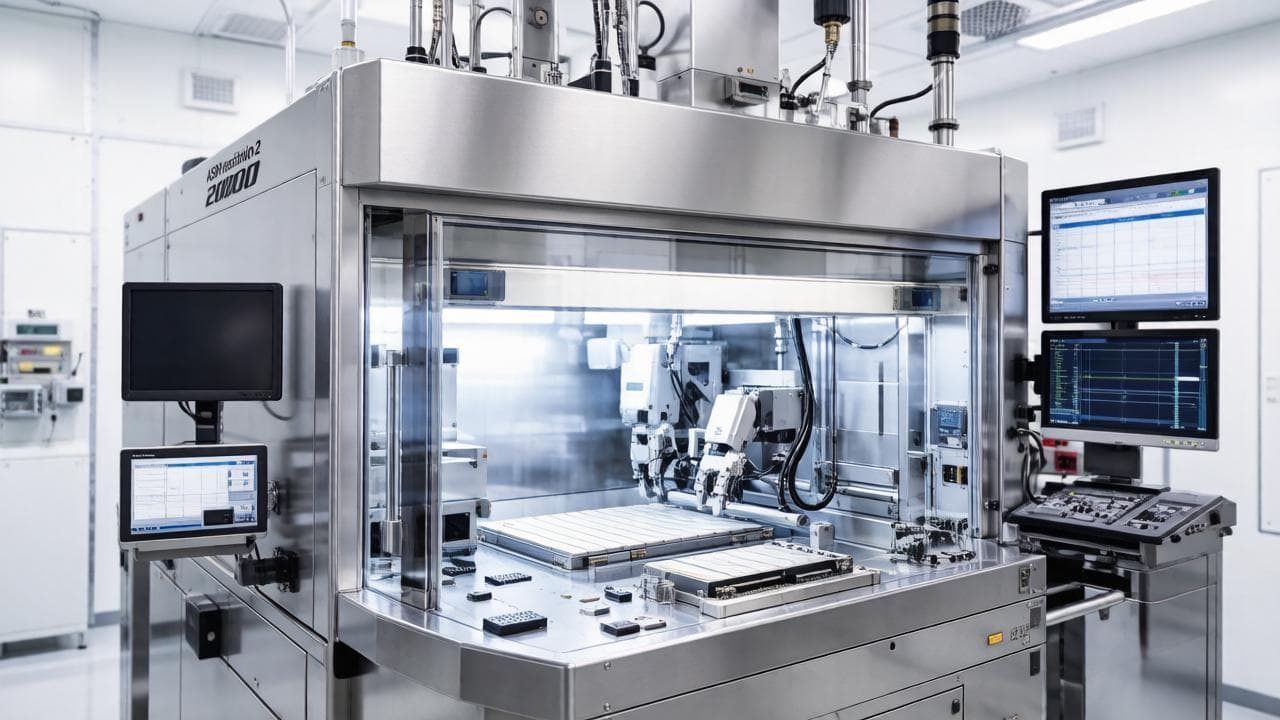
1.5 billion rubles have been allocated for the development of a molecular beam epitaxy system for obtaining heterostructures based on indium, aluminum, gallium, and arsenide compounds. Another 463.7 million rubles will be directed to create a system for growing silicon-germanium layers on 200-millimeter silicon wafers using gas-phase epitaxy. Both tenders were published on June 1, 2026, on the public procurement portal.
The "Epitaxy-SiGe" system is intended to replace the Dutch ASM Epsilon 2000 equipment, which is used for growing epitaxial layers on 200 mm wafers. The "Citadel" system is designed to replace the French Riber 49 and American Veeco GEN200 – there are no direct domestic analogues today. It is intended for obtaining heterostructures on wafers with a diameter of 76 and 100 millimeters.
As part of the "Epitaxy-SiGe" R&D, the contractor must conduct modeling and manufacture three mock-ups of key components: a gas-phase epitaxy reactor, a robot loader, and a pre-epitaxial processing module. The reactor must withstand heating up to 1180 degrees Celsius and operate in a pressure range from low vacuum to atmospheric. The growth rate of the silicon layer must be at least 6 micrometers per hour, and the silicon-germanium layer must be at least 0.5 micrometers per hour with a germanium content of 10 percent or more.
For the "Citadel" R&D, the developer must create design documentation and manufacture a prototype of the system with group substrate loading. The system must process at least five 76-millimeter diameter substrates or three 100-millimeter diameter substrates simultaneously. The accuracy requirements are high: layer thickness uniformity on the wafer – no more than 3 percent, n-type doping uniformity – no more than 5 percent, p-type – no more than 20 percent.
Critical components – vacuum chambers and pumps, molecular sources, shut-off and vacuum valves, central controller, and software – must be of Russian production. Foreign parts are allowed only with justification and written approval from the Ministry of Industry and Trade. Work on "Epitaxy-SiGe" will be completed by June 2029, and on "Citadel" by October 2030.
Read more on the topic:
Never miss our newsAdd this site to your preferred sources to see us more oftenAdd on Google

















