Translated with AI from the Russian original.
Right under the "Rassvet" stadium in the Oktyabrsky district of Krasnoyarsk, two metrotram tunnels have been joined. One of them is a legacy from the 1990s, the other is a modern excavation by the Chinese shield "Evgeniya". At a depth of about 40 meters, a technological breakthrough was made using the mining method – an opening about 10 meters long between the right and left tunnels. Before starting work, both sections were reinforced with metal structures.
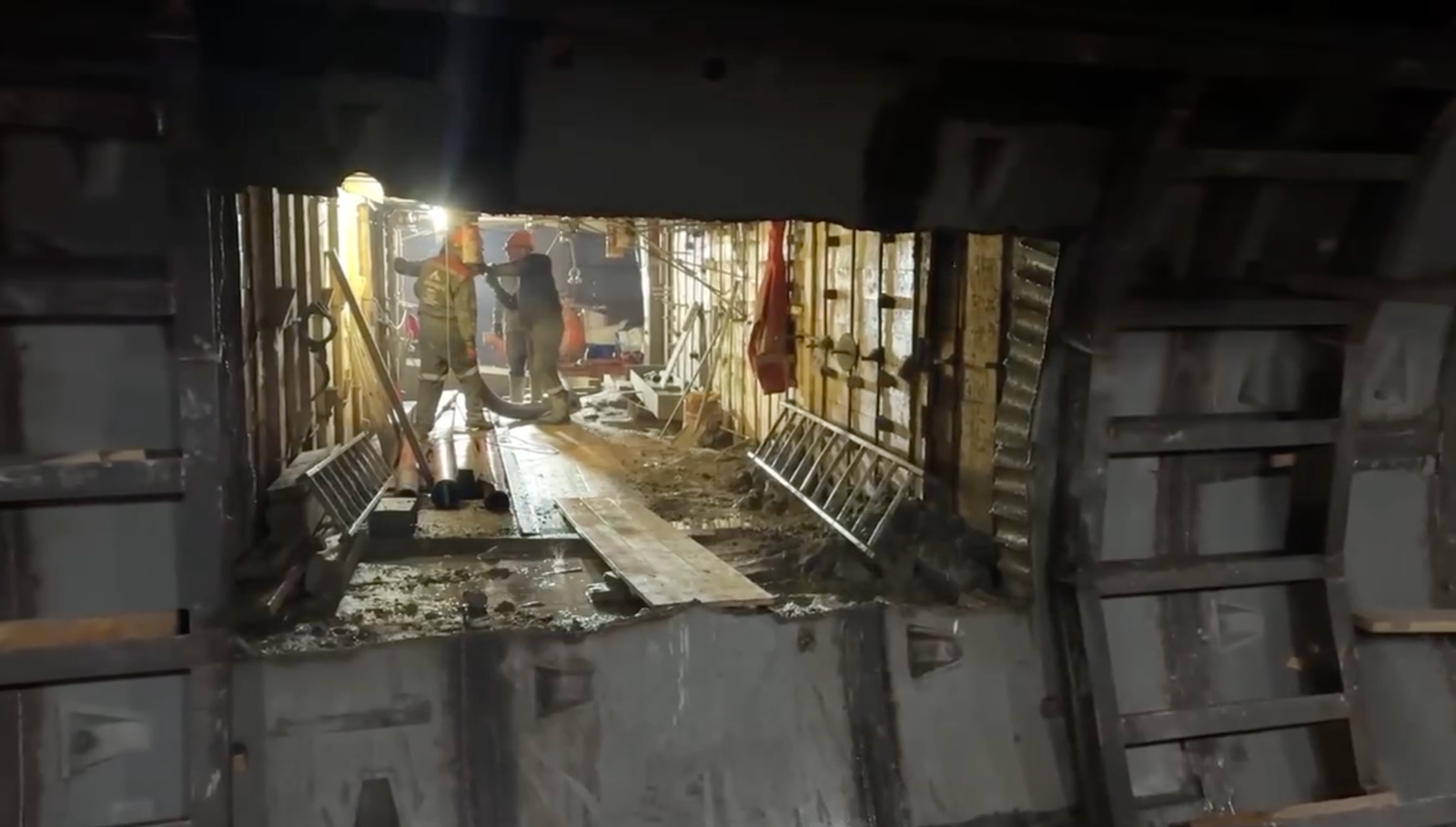
Now this junction will serve as an emergency exit during construction, and after the line is launched, engineering communications will be laid through it.
The junction point was chosen approximately one kilometer from the future "Vysotnaya" station, where the rock consists of a variegated stratum of the Lower Pavlovsk Formation, formed even before the appearance of dinosaurs.
What Shields Are Working Under Krasnoyarsk
Up to six tunnel boring machines (TBMs) are involved in the construction of the first line. They differ in mass, diameter, manufacturer, and tasks.
"Evgeniya" ("Yenisei")
A Chinese-made tunnel boring complex (China Railway Construction Corporation structures). One of the most powerful on the project. It operates on the "Vysotnaya" – "Kopylova" section, where it is laying the left inter-station tunnel, approximately 2.6 km long. Tunneling is carried out in complex hydrogeological conditions.
"Anastasia"
A modern mechanized shield, launched in 2025 from the "Ploshchad Revolyutsii" station. It works in the direction of "Vokzalnaya". The design tunneling speed for complexes of this class usually reaches 200–300 meters per month; actual rates depend on geology.
"Irina"
A twin shield to "Anastasia", also involved in the "Ploshchad Revolyutsii" – "Vokzalnaya" section. It provides for the tunneling of the second (parallel) tunnel. The use of two TBMs allows for synchronized construction of both tracks.
"Valentina"
A large tunnel boring complex weighing about 600 tons. As of 2025–2026, it was in the stage of assembly and preparation for launch. It is intended for tunneling one of the inter-station sections of the central part of the line.
"Ekaterina" and "Solomeya"
Two Russian-made complexes with similar characteristics.
Key parameters:
- mass about 480 tons,
- diameter about 6 meters,
- installation length — about 80 meters.
Both shields have been operating since 2024 on the section from "Ulitsa Shakhtyorov" towards the city center. It was with their launch that the active phase of modern tunneling actually began.
Accurate figures for distances covered are regularly updated and depend on the stage of work, but we are talking about kilometers of tunnels completed by each complex.
In total, the project uses industrial tunnel lining made of high-precision reinforced concrete rings, assembled directly behind the shield.
What Was Used to Build the Krasnoyarsk Metro in the 1990s
The first stage of construction relied on different equipment.
Lovat (Canada)
A Canadian tunnel boring complex that became a key machine in the early stage. With its help, more than 2 km of tunnels were driven from the "Vysotnaya" station. The shield was highly accurate and allowed tunneling with minimal impact on the surface.
KPSh (domestic shields)
Used in separate sections. Compared to modern TBMs, they had significantly lower productivity and a higher level of manual labor. Subsequently, some equipment was modernized.
By the early 2010s, several kilometers of underground workings had been built in Krasnoyarsk, but due to lack of funding, the project was stopped and mothballed.
From Long-Term Construction to Metrotram
Construction of the Krasnoyarsk Metro began in 1995. In the 2000s–2010s, work was carried out intermittently, and then effectively frozen.
Upon relaunch, the project was redesigned into a metrotram format – a more economical system combining underground and surface sections.
The first stage includes about 11 km of line and 6 stations. Part of the previously built tunnels will be integrated into the project, which will reduce construction time and cost.
The total cost of the project is estimated at more than 90 billion rubles, and the completion of the first stage is planned by the end of the decade.
Read more on the topic:
- Krasnoyarsk metro completion deadline postponed to 2028: the contract with the general contractor will have to be rewritten
- Unique Tunnel Boring Machine "Maria" Starts Drilling Second Tunnel of Chelyabinsk Metrotram
- NPO YaMZ and Uralmashzavod have begun developing a fully domestic tunnel boring complex
Never miss our newsAdd this site to your preferred sources to see us more oftenAdd on Google

















