Translated with AI from the Russian original.
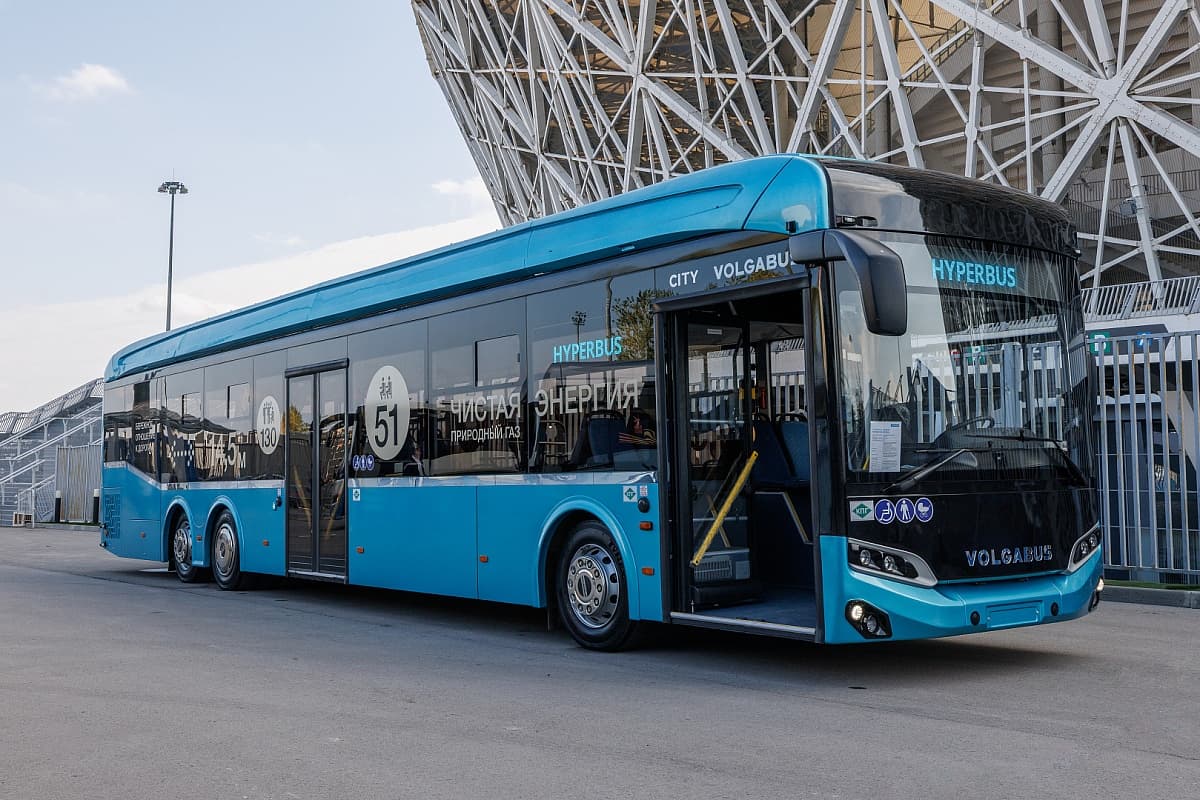
Road trials of the high-capacity "Hyperbus" bus developed by Volgabus Group have begun in Yekaterinburg. On March 28, 2026, the vehicle was put on route No. 64, according to the Telegram channel "Buses of Yekaterinburg." The three-axle bus is 14.5 m long and is designed to carry 130 passengers, including 51 seated passengers. The 205 kW power unit has a classic longitudinal layout, which simplifies access to components during maintenance. The presence of a third steering axle improves maneuverability and reduces the load on the road surface. The independent front suspension ensures a smooth ride and stability in turns. Earlier, similar Hyperbus trials were completed in Chelyabinsk.
Third axle and independent suspension: how the "Hyperbus" is designed
The bus is built on a three-axle chassis with a 6×2 wheel arrangement (the middle wheels are driven). The rear axle is steering, allowing the nearly 14.6 m long vehicle to maintain a turning radius comparable to 12-meter models. The pneumatic suspension on all axles is equipped with the electronically controlled ECAS system with a kneeling function (tilting to the right side for easier boarding). The front suspension is independent, with two hydraulic shock absorbers and an anti-roll bar.
According to the manufacturer, the number of seats in the urban version of the "Hyperbus" is 90% higher than that of a standard 12-meter low-floor bus, and 40% higher than that of an 18-meter articulated "accordion" bus. In the suburban version, luggage compartments with a total volume of 6 cubic meters are provided. The bus can be equipped with a Weichai gas engine (205 kW, Euro-5) or a YaMZ-53613 diesel engine (228 kW, Euro-5). The transmission is a six-speed automatic.
Technical specifications of the "Hyperbus" bus (6270G4 / 627001)
- Dimensions (L×W×H): 14 520 × 2550 × 3050 mm (3350 mm with cylinders)
- Passenger capacity / seated passengers: 124–130 / 52–56
- Wheel arrangement: 6×2 (middle axle driven)
- Engine: Weichai WP7NG290E51 gas engine (205 kW, 2100 rpm) or YaMZ-53613 diesel engine (228 kW, 2300 rpm)
- Transmission: automatic FC6A145RB, 6AP1220B or 6AP1720B
- Suspension: pneumatic, front — independent, ECAS, kneeling
- Brake system: pneumatic, three-circuit, disc brakes, ABS/ASR
- Gas cylinders (for the gas version): 8 type 3 metal-composite cylinders, total volume 984 L
From Chelyabinsk to Yekaterinburg: the trials continue
Before entering route No. 64 in Yekaterinburg, the "Hyperbus" underwent similar trials in Chelyabinsk. Both agglomerations are among the million-plus cities, where the problem of passenger flow during rush hours is especially acute. The 14.5-meter vehicle with an increased number of seats is positioned by the manufacturer as an intermediate link between a standard 12-meter bus and an articulated "accordion" bus: it is more compact than the latter, but more capacious than a regular low-floor bus.
The number of seats (more than 50) for urban route transport in Russia remains rare: most large-class buses offer 25–35 seats. Increasing the share of seated passengers reduces fatigue on longer trips within agglomerations and increases the overall attractiveness of public transport.
Read more materials:
- Russia's longest single-unit bus, the Volgabus-627001, began carrying passengers to Domodedovo Airport
- Six KamAZ-52222 electric buses of the A5 generation entered route No. 214 in Moscow's Eastern District
- The new Russian CITYMAX 9 bus was sent for three-month trials to Chuvashia
Never miss our newsAdd this site to your preferred sources to see us more oftenAdd on Google

















