New active regions on the Sun may rotate onto the side visible from Earth within the next 24 hours, which will lead to an increase in the number of flares. This was reported by the Laboratory of Solar Astronomy of the Space Research Institute (IKI) of the Russian Academy of Sciences on January 29, 2026.
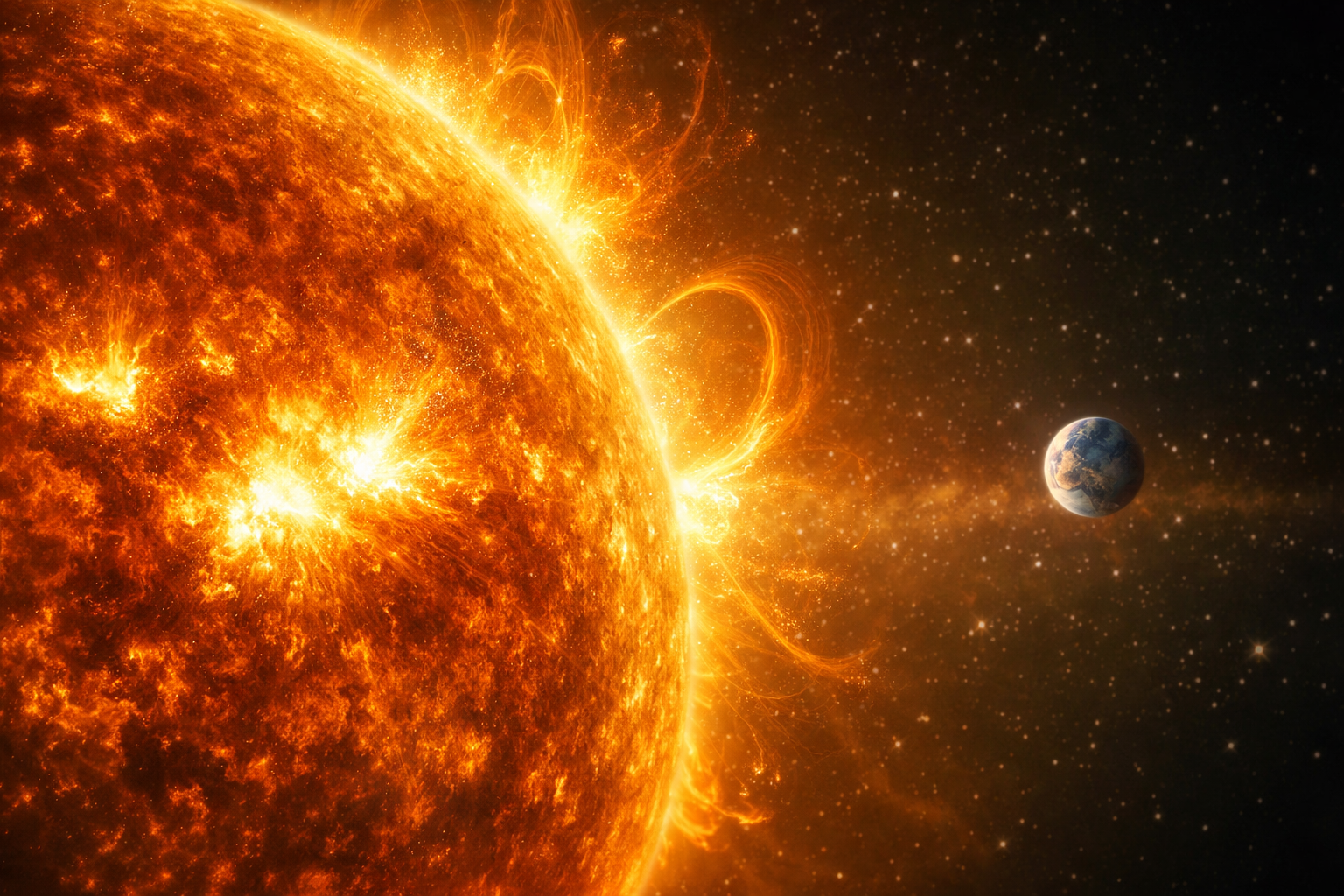
The laboratory noted that the regions on the far side of the Sun responsible for the strong flares on January 25 may come into view within the next 24 hours. In this regard, a gradual change in the trend and a renewed increase in the number of flares are expected.
The potential scale of the increase can be assessed when these regions are fully within the field of view. At present, flare activity is low and continues to decline.
The geomagnetic situation on January 29 is assessed as moderately disturbed. Over the past 24 hours, short-term disturbances and a low-level magnetic storm were observed. During the next 24 hours, the risks of recurring magnetic storms will remain.
The speed and temperature of the solar wind are elevated due to the influence of a coronal hole. The hole itself is microscopic in size (visible near the Sun's right edge) and affects the planet solely because of its favorable position. Earth will remain in the zone of influence of the coronal hole for about another 24 hours. During this period, brief geomagnetic disturbances and storms are possible.
The day before, approximately from 6:00 p.m. to 8:00 p.m. Moscow time, intense auroras (8 out of 10 points) were observed, recorded mainly in the northwestern region of Russia.
The combination of active regions rotating onto the visible side of the Sun and the continuing influence of the coronal hole may intensify space weather in the coming days and increase the likelihood of geomagnetic disturbances.
Read more materials on the topic:
- Scientists are perplexed: a powerful double explosion occurred on the far side of the Sun on December 23
- The Sun swallowed the largest cluster of spots
- The G4.7 magnetic storm following the first powerful X1.95-class solar flare of 2026 has ended
Never miss our newsAdd this site to your preferred sources to see us more oftenAdd on Google

















