The Cherepovetsky Shipyard successfully launched the tug-pusher "Vasily Vereshchagin" of the TSC.395M project. The news was shared by the mayor of the city, Roman Maslov, in his Telegram channel.
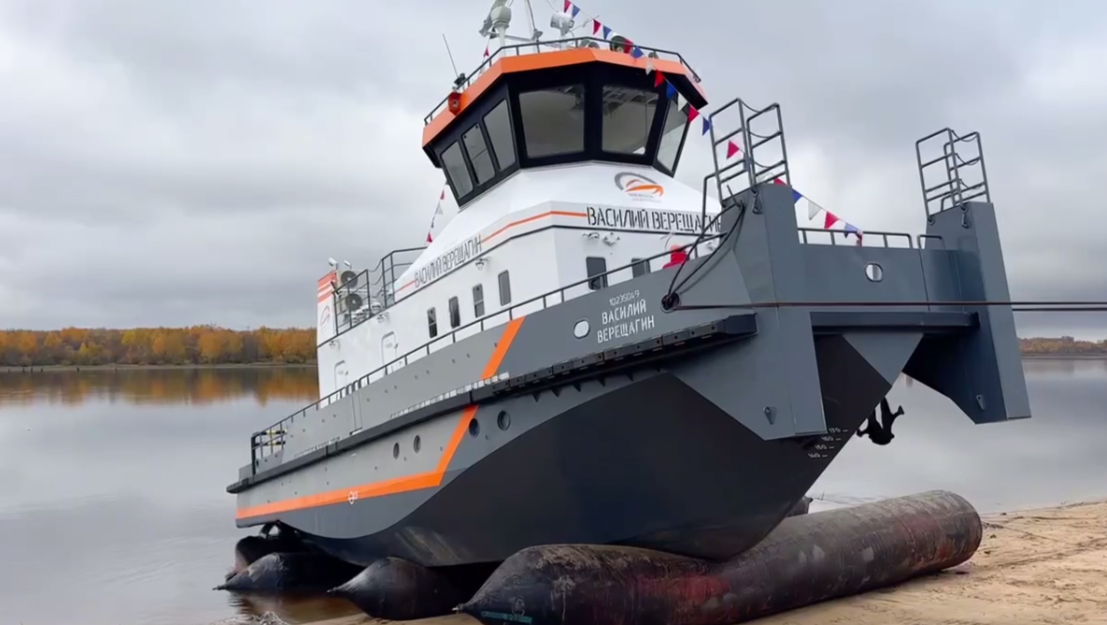
The Cherepovetsky Shipyard continues the tradition of naming new vessels after outstanding residents of our city and region. "Cherepovetsky Shipbuilder", "Ivan Milyutin", "Engineer Zinger" have already been launched, and now - "Vasily Vereshchagin".
The State Transport Leasing Company (GTLK) has signed a contract with the Black Sea Shipyard (ChSZ) for the construction of five tugs of the TSC-395M project. The project is being implemented as part of an investment program to update the Russian civil fleet with funds from the National Welfare Fund (NWF). The first two tugs will be delivered to the customer in 2024, and the remaining three are planned to be accepted in 2025.
The power of 1300 hp allows towing eight or more barges at a time. The tug is equipped with a lifting wheelhouse to improve visibility when piloting long trains.
Technical characteristics:
- Vessel class RKO - O2,0 (ice 30).
- Overall length - 22.55 m.
- Overall width - 7.20 m.
- Board height at midship - 2.845 m.
- Gross tonnage - 143 RT.
- Total power of main engines - 960 kW.
Earlierwww1.ru reported that the possibility of building gas turbines of the GTE-300 type is being studied at the Power Machines enterprise.
Read also:
- Seven years have passed since the certification of PD-14
- Another enterprise will deal with solving the problem of a critical shortage of components for Russian aircraft
- Based on the Russian "Sprut-SDM1": a light amphibious tank called Bharat was presented in India
Never miss our newsAdd this site to your preferred sources to see us more oftenAdd on Google