Translated with AI from the Russian original.
Comet C/2025 A6 Lemmon is unlikely to show its tail to the average person with binoculars. Early forecasts of rapid growth in the comet's brightness, as well as information about the current magnitude of the body, require clarification, noted the Laboratory of Solar Astronomy of the IKI and ISZF.
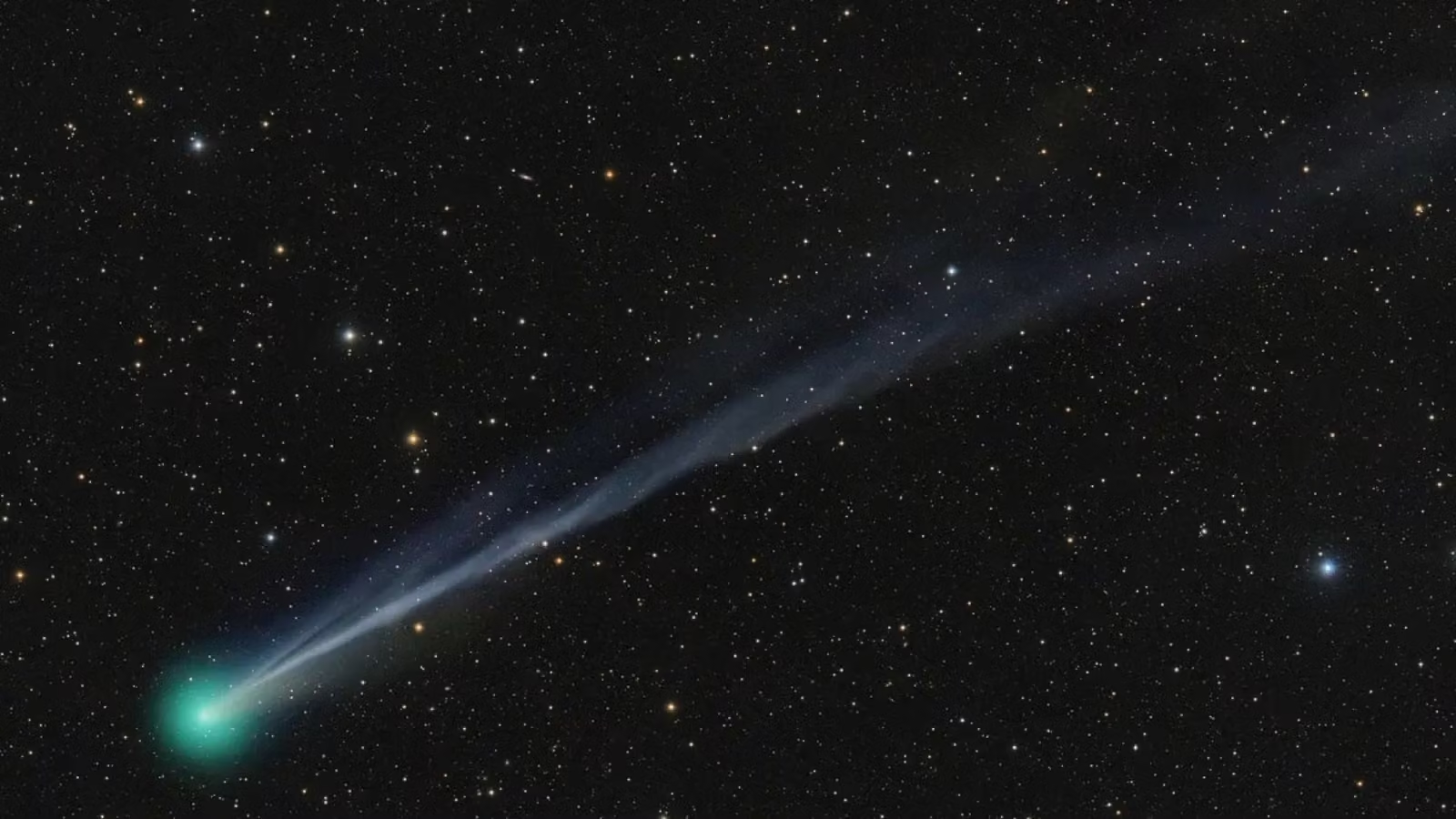
The magnitude of the body, which is about 6 units, is above the sensitivity threshold of the eye, but only for compact bodies (stars, planets), all of whose radiation is concentrated in one point, the laboratory explained. Only experienced observers with skills in observing the starry sky will be able to discern the central body of the comet, like a very faint star, in strong professional binoculars.
Comet C/2025 A6 Lemmon currently occupies several square degrees in the sky, and the "smearing" of radiation over such an area leads to a sharp decrease in the surface brightness of the tail.
At the moment, the body as a comet, that is, the nucleus with a tail, can be observed to a limited extent in good lenses with high aperture ratio with an exposure time of several tens, and preferably at least 100 seconds. Obtaining more or less high-quality photographs is possible in telescopes with an aperture diameter of 100 mm and with approximately the same total exposure time.
Overall, it is now almost clear that the expectations for the comet's visibility, which were still there 2 weeks ago, turned out to be greatly exaggerated. At the moment, based on the growth of radiation flux and the surface brightness of the body, the possibility of seeing it with the naked eye, even at its peak brightness, seems very unlikely.
The body will reach its maximum brightness around October 30, when it will increase its luminosity by about 15 - 20 times relative to the current value. This, unfortunately, will be absolutely insufficient for visual observation of the object, especially when it comes to simple hand-held observations.
Earlierwww1.ru wrote that comet C/2025 A6will approach Earth in October.
Read more materials on the topic:
- Eruptions of ice volcanoes caused a powerful flash on comet 29P/Schwassmann-Wachmann
- "And this light-transmitting sphere": Russian astronomer discovered the 15th comet in his career
- "Dark Comet" 2005 VL₁: asteroid or lost Soviet space station "Venera-2"?
Never miss our newsAdd this site to your preferred sources to see us more oftenAdd on Google

















