The 171st Separate Design and Technology Bureau of the Remvooruzhenie holding (part of RT-Capital of the Rostec State Corporation) has created documentation for a new line of non-self-propelled barges. These vessels are designed for operation in shallow areas of rivers and seas, such as the Caspian and Azov Seas, as well as in coastal areas where the depth does not exceed 3-4 meters.
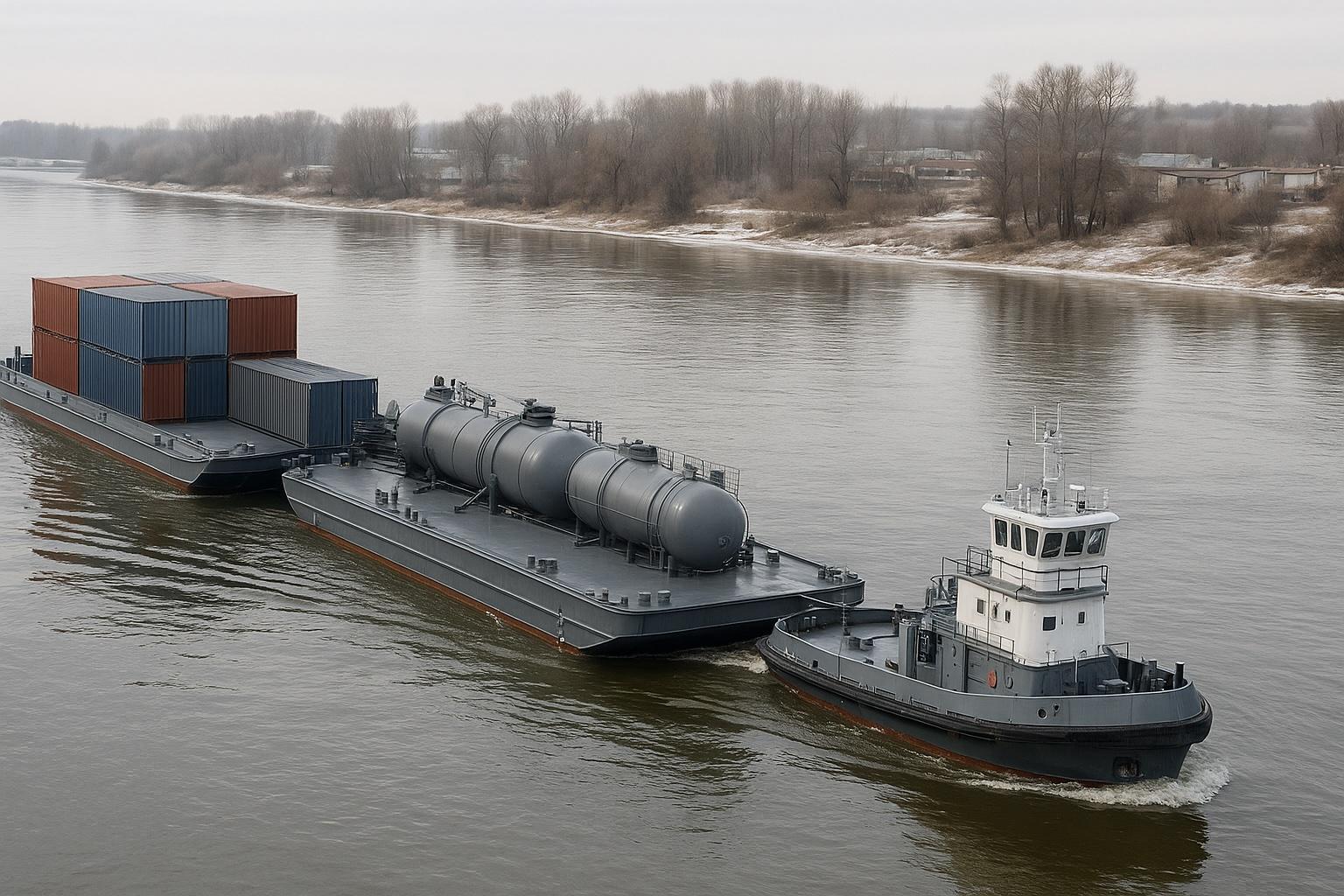
The project aims to update the outdated fleet of transport barges: today, more than 40% of the vessels used on shallow rivers are over 50 years old, and over a thousand units will be decommissioned in the coming years. The new barges will allow for the establishment of transportation without costly dredging and will be a solution for regions with rapidly shallowing rivers, especially in Siberia and the Far East.
At the first stage, two types of vessels are proposed. A container barge with a length of 83.2 meters and a displacement of 2200 tons will be able to carry up to 20 specialized containers or 10 standard twenty-foot containers. An oil barge with a length of 24.5 meters and a draft of only 1.7 meters is designed for the transportation of petroleum products and chemical liquids with a volume of up to 50 cubic meters, including complex routes, such as supplying Arctic facilities and small refineries.
A key feature of the new line is the possibility of autonomous unloading without port equipment and operation on the principle of a "river train": a tug is capable of towing up to three barges simultaneously. This ensures route flexibility, reduces downtime, and lowers logistics costs. In the future, the project can be adapted for the Northern Sea Route - for this, options with cargo heating, reinforced ice protection, and expanded automation are provided.
Read also on the topic:
Barge of project DC9203 laid down in the Nizhny Novgorod region
Barge of the new generation RDB 66.68MA project was launched in the Tomsk region
Dry cargo barge-platform built at the Stalker plant
Never miss our newsAdd this site to your preferred sources to see us more oftenAdd on Google