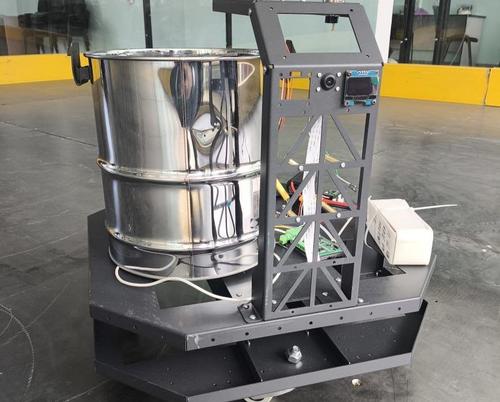
A robot for cleaning large premises, using domestic electronics, has been developed at the Novosibirsk State Technical University (NSTU). This was reported in the press service of the university.
The uniqueness of the development lies in the fact that we are creating our own electronics, which will ultimately allow us to obtain an inexpensive design that can be replicated. The project is also good from the point of view of training, because it gives students practical engineering skills: students can refine each element, change something, improve it.
The robot is capable of playing quiet music during cleaning. This makes its approach less unexpected and increases safety.
The main task of the device is to correctly build the trajectory of movement and avoid collisions with obstacles. The robotic complex includes a technical vision camera, motor controllers and control panels.
To date, a prototype is ready - a moving model, software has been developed, and a vacuum cleaner unit is being manufactured. We have to refine the interface and software, as well as manufacture a plastic case.
In the future, it is planned to equip the cleaning robot with a lidar, which will allow it to build a map of the room and accurately navigate in space.
Earlierwww1.ru reported that a new Russian cleaning robotwill replace dozens of janitors.
Read materials on the topic:
Better than any janitor: Pixel cleaning robots are hired for permanent work in Moscow parks
AI will be used in Russia to maintain cleanliness in cities
Yandex is going to expand the production of delivery robots
Never miss our newsAdd this site to your preferred sources to see us more oftenAdd on Google