Engineers from the Moscow Institute of Physics and Technology (MIPT) have presented the first aerosol printer in Russia capable of printing microchips, biosensors, and neural implants with element thicknesses down to 10 micrometers. Unlike traditional methods such as photolithography, the new development does not require complex equipment and significantly speeds up the production process.
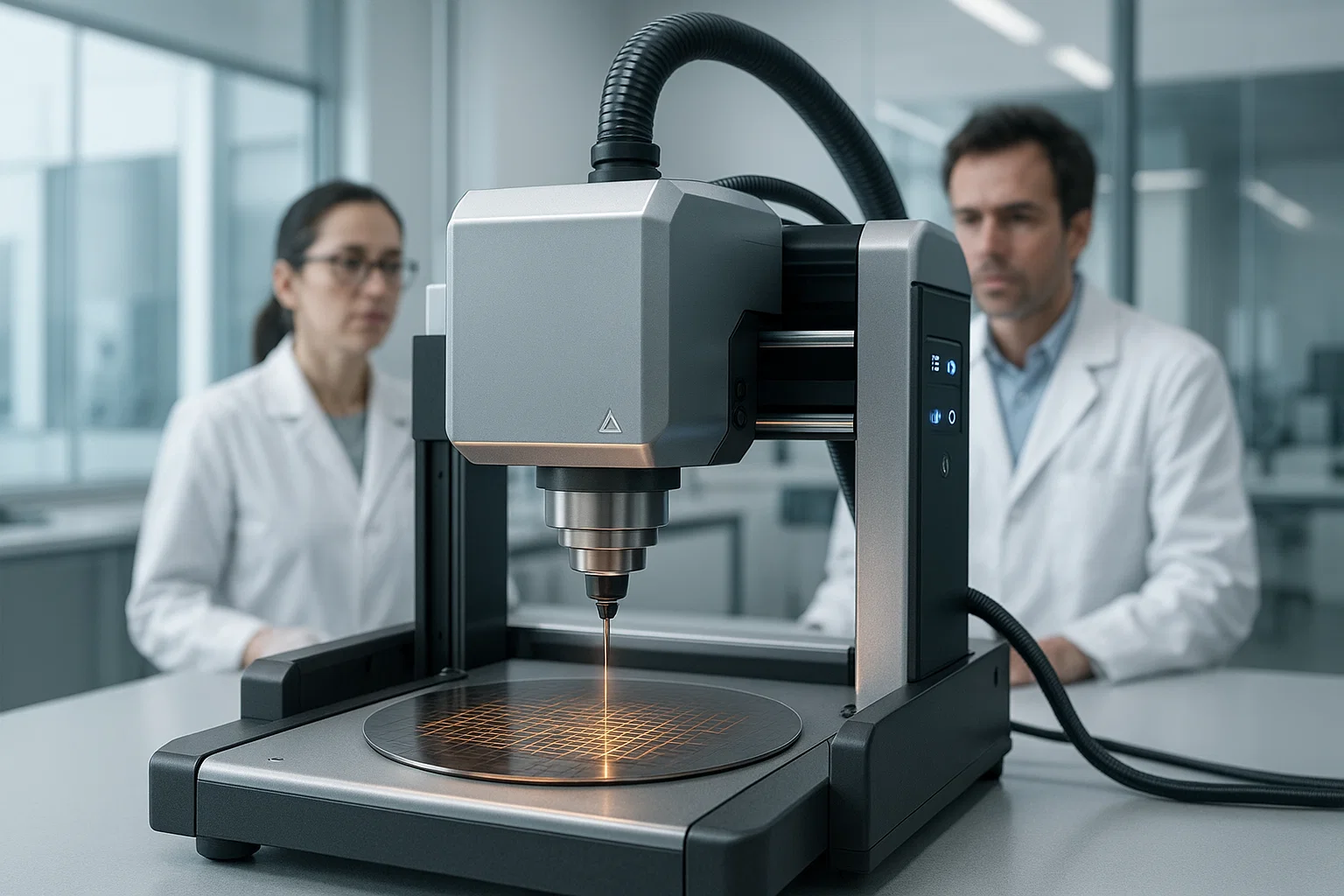
We started developing the aerosol ink printer in 2023 to address the most important tasks of domestic microelectronics. Initially, it was created simultaneously as an installation for scientific research and as a machine for large factories in Russia. Therefore, its range of applications is very wide: from prototyping in development and research departments to creating serial devices of various types.
The key advantage of the technology is the high printing speed (up to 10 cm/s), which allows creating microchips with an area of 10 cm² in just two minutes. For comparison, classical methods take from 10 minutes to half an hour. The device supports working with various materials, including glass, silicon, flexible polymers, and biocompatible coatings, which opens up opportunities for use in medicine, for example, in the manufacture of implants and antimicrobial coatings.
Read more materials on the topic:
Compact optical filters made of quartz and silver created by Krasnoyarsk scientists
Never miss our newsAdd this site to your preferred sources to see us more oftenAdd on Google















![Growth Point: After 5G Launch, Mobile Internet in Russia Accelerated by 20%","subtitle":"TelecomDaily recorded an upload speed increase of 19.7%, and download speed of almost 14%","announce":""}[]}],](https://media.ixbt.site/fit-in/320x/ixbt-data/1727896/ai-image-nvgq0a0v5cjnyxwoc8xpelva.webp)