Russian military personnel have begun to use the Soviet multiple launch rocket systems (MLRS) "Grad" in a new way. Most often, they now operate from permanent camouflaged positions.
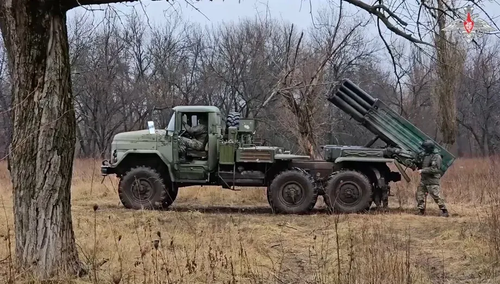
As long as the vehicle is in good working order, the soldiers try not to move it, even in the dark. It is almost impossible to recognize the 1963 MLRS, completely covered with nets and gratings, until it approaches closely.
Only at dawn did it become clear that the vehicle had been moved from its positions in the dark, with the intention of reaching a safe area in the dark.
The troops also noticed a rare modification of the "Grad" multiple launch rocket system from the Tula NPO "Splav". This is the lightweight modification 9K55 "Grad-1", which entered service in 1976 and was produced in a series of 500 units, compared to 8500 units of the standard 9K51 "Grad" MLRS.
Another advantage of the "Grad-1" system is the reduced longitudinal channels of the guides above the surface in a horizontal position, which facilitates and speeds up the process of reloading ammunition.
Earlier, www1.ru reported that the digital filling of the latest Su-57 fighter has become known, it even has copper lines.
Read more materials:
Last flight: Mi-8 helicopter crashed in Russia due to technical malfunction
Never miss our newsAdd this site to your preferred sources to see us more oftenAdd on Google