On the night of January 21 this year, residents of Russia were able to witness a rare astronomical phenomenon - a parade of planets. This time it was truly grand - as many as six celestial bodies lined up on one side of the Sun. This was reported by the press service of the Moscow Planetarium.
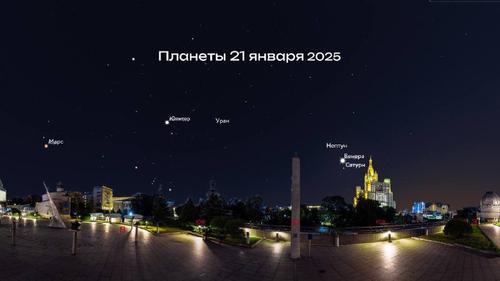
Venus, Saturn, Jupiter, and Mars appeared in the evening sky - they could be observed with the naked eye. A telescope was required to observe Neptune and Uranus.
Observations should begin after 17:30 Moscow time. The bright Venus can be easily found in the sunset sky, Saturn is located slightly below, Neptune is slightly above and to the left of Venus. After 21:00, this trio will disappear behind the horizon, but Jupiter and Mars will shine high in the sky all night.
Experts note that all six planets will be visible in the evening sky for the next month in clear weather. And on February 28, Mercury will join the parade of planets.
Earlierwww1.ru reported that on the last day of winter the planets willline up in an invisible parade.
Read related materials:
In November, the Moon eclipsed stars and star clusters five times
A rare conjunction of Mars and Jupiter occurred on August 14
"The sun is starting to scare": the star "fired" eight strong flares in a day
Never miss our newsAdd this site to your preferred sources to see us more oftenAdd on Google










![Growth Point: After 5G Launch, Mobile Internet in Russia Accelerated by 20%","subtitle":"TelecomDaily recorded an upload speed increase of 19.7%, and download speed of almost 14%","announce":""}[]}],](https://media.ixbt.site/fit-in/320x/ixbt-data/1727896/ai-image-nvgq0a0v5cjnyxwoc8xpelva.webp)