An archival photograph published by Rostec showed two cars that could have changed the history of the domestic automotive industry. On the left is one of the early variants of the future VAZ-2110, on the right is the experimental VAZ X concept. The photo was taken in Tolyatti in 1982–1984, when AvtoVAZ first seriously considered a next-generation car.
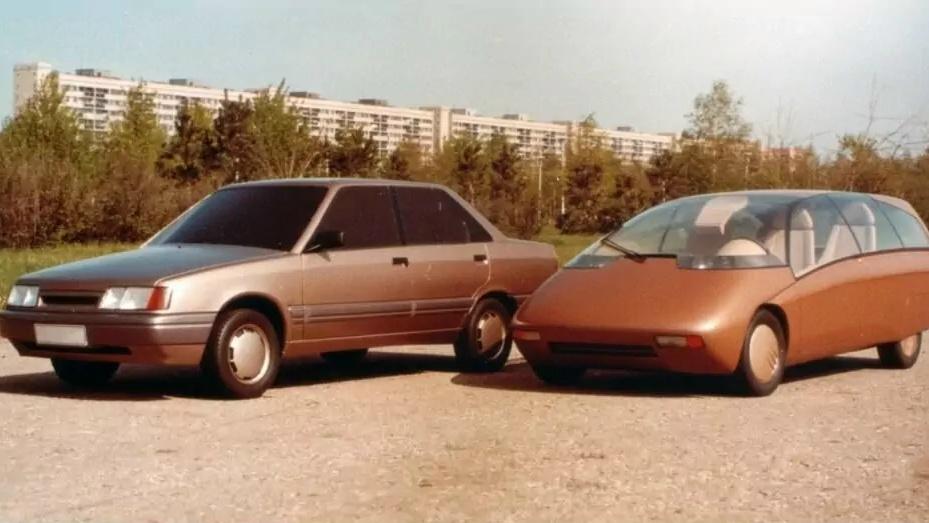
At first glance, it's hard to believe that the car on the left is related to the future "ten". The production VAZ-2110, which went into production only in 1995, received a completely different design. However, this is what the first searches for a new family looked like. Designers experimented with a wedge-shaped silhouette, large angles of inclination of the windows, and improved aerodynamics – directions that defined global automotive fashion in the early 1980s.
The project was repeatedly revised. This was largely due to the fact that the main efforts of the plant were focused on launching the "Sputnik" family (VAZ-2108/2109), and the promising "ten" was constantly postponed. As a result, more than ten years passed between the first mock-ups and the production car.
Even more interesting is the car on the right – VAZ X. This was not a pre-production model, but a full-fledged concept created to test new ideas. Panoramic glazing, almost closed wheel arches, smooth body lines, and an extremely low silhouette make it look more like European concept cars of the late 20th century than a Soviet car of the early 1980s. The car was never intended for mass production – it served as an experimental platform for studying aerodynamics, layout, and promising design.
That is why VAZ X remains one of the most mysterious developments of AvtoVAZ. Little official information about it has been preserved, and most of the photos were not published for a long time. Many of the concept's solutions never found direct embodiment in production cars, although individual ideas were later used in the design of new models.
Today, these two prototypes are perceived as a symbol of an era when the Soviet automotive industry still allowed itself bold experiments. One project eventually turned into a production "ten", albeit completely unlike the early mock-up. The second forever remained a car from an alternative future – what AvtoVAZ could have become if history had turned out differently.
Read more on the topic:
Never miss our newsAdd this site to your preferred sources to see us more oftenAdd on Google

















