Translated with AI from the Russian original.
Scientists from Perm Polytechnic and Immanuel Kant Baltic Federal University investigated collagen from jellyfish, salmon, herring, and Baltic herring and, for the first time in Russia, developed a hydrogel formulation for 3D bioprinting. This will allow the creation of materials for restoring damaged tissues from fish industry waste, making their production cheaper and more accessible.
Traditional sources of collagen for biomedical purposes are raw materials from cattle and pigs. However, such material can cause rejection, allergies, and carries risks of infection transmission. Artificial collagen could be an alternative, but its production remains complex and expensive. Collagen from marine organisms has lower immunogenicity, and it can be obtained from fish industry waste.
Collagen extracted from jellyfish, salmon, herring, and Baltic herring was used to prepare hydrogels. These species were chosen due to their widespread presence in Russian seas, which will ensure the availability of raw materials. In addition, marine collagen is structurally similar to human collagen.
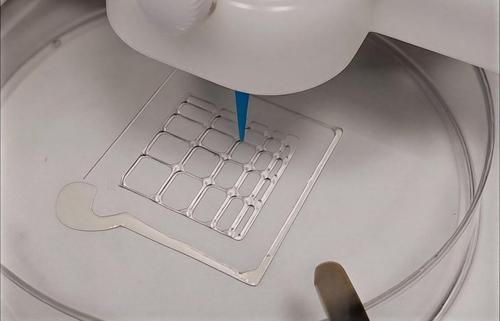
During the study, scientists added sodium alginate and created several variants of bioinks, varying the ratio of components. For each type of hydrogel, individual 3D bioprinting parameters were selected: material feed rate and temperature. The criteria were uniform application, shape retention after solidification, and the ability to form multilayer structures.
After curing the samples, mechanical tests for elasticity and strength were performed. The hydrogel based on jellyfish collagen showed the best properties. In addition, this material proved to be the most technologically advanced in preparation.
Scientists formed both single-layer objects of simple geometry and multilayer structures, which confirms the suitability of the obtained regimes for printing objects of various complexity. The next step will be to study the process of material degradation over time. Understanding how quickly the printed scaffold will be replaced by the body's own tissues is a key factor for the medical application of the developed bioinks.
Read more on the topic:
Never miss our newsAdd this site to your preferred sources to see us more oftenAdd on Google

















