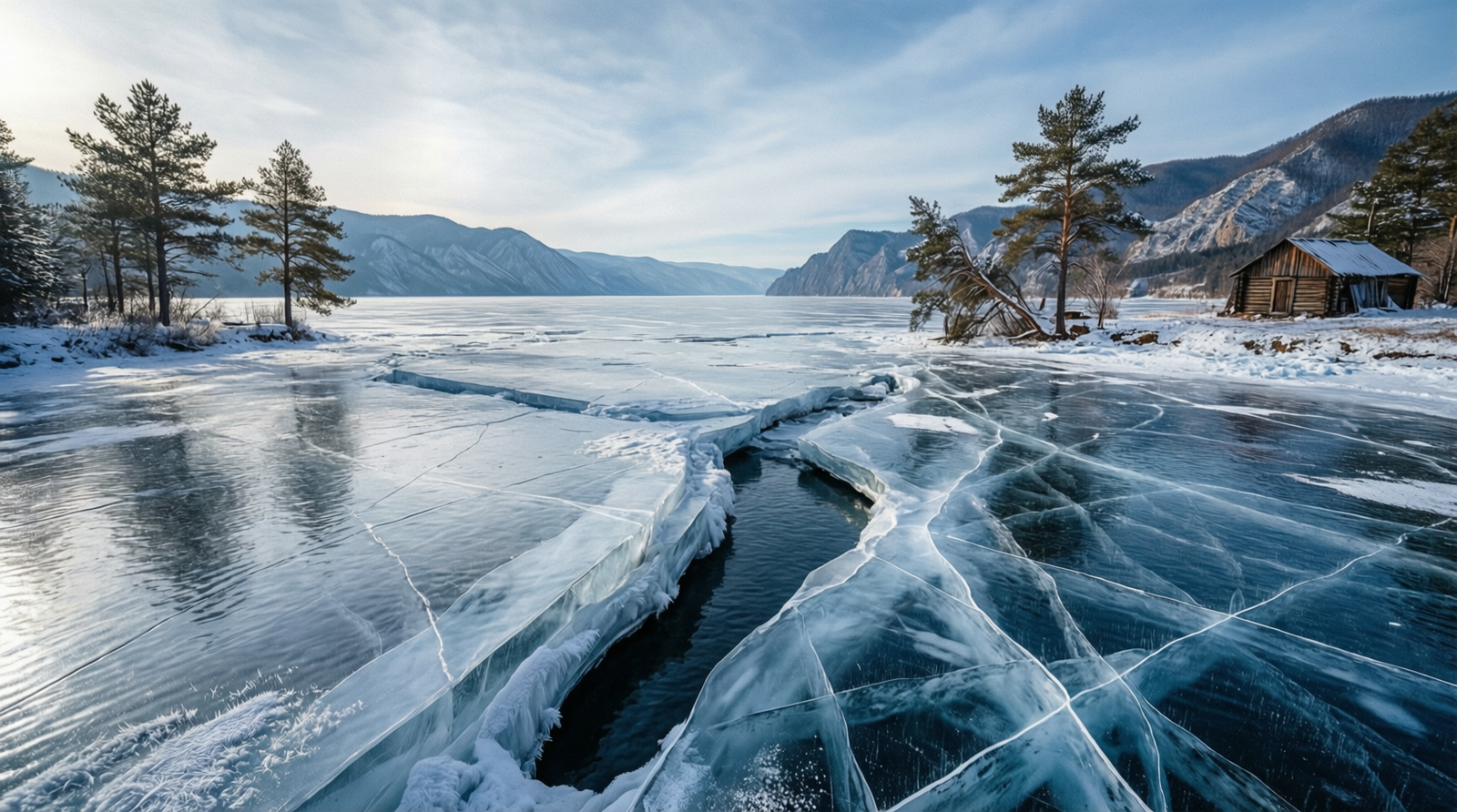
Russian scientists have discovered a high concentration of microplastics in the snow and ice of Lake Baikal. Cleaner crustaceans live near these accumulations. It turned out that the greatest amount of synthetic particles is in the lower edge of the ice, where the larvae of the epishura crustacean live. This is a key filter feeder that helps maintain Baikal's purity.
Scientists from TSU developed a methodology for isolating and counting microplastics from biological matrices, patented it, and applied it to samples.
Until recently, the study of microplastics in Baikal was fragmentary in nature. Mainly, surface water was studied during the summer period, which provided an idea of only the \"tip of the iceberg\".
In the process, the specialists found that microplastics enter the lake's food chain — they stick to aquatic plants, after which they are accidentally ingested by gastropod mollusks and amphipod crustaceans. Epischura baikalensis crustaceans make up to 100% of the community under the ice cover.
At Irkutsk State University, which also worked on the study, they explained that ice and snow act as giant concentrators of pollution.
Snow collects plastic dust carried by the wind, and ice literally freezes particles from the water into itself. The highest concentration of MP particles was recorded at the lower edge of the ice.
Yulia Frank, Director of the TSU Microplastics Research Center in the Environment, added that Baikal still remains clean compared to other large bodies of water in the world. In the Great Lakes of the United States, up to 100 thousand particles per cubic meter of water are found, in the lakes of Altai — up to 11 thousand, and in Lake Rewalsar (India) this figure reaches 130 thousand particles per cubic meter.
Read more materials on the topic:
- Baikal pollution prevented: Rosatom eliminated a phenol settling pond in Ulan-Ude
- Will detect fluctuations even at the bottom of Baikal: an innovative ultra-precise instrument for measuring temperature has been developed
- Oil discharges on the surface of Baikal were captured by the camera lens of local researchers for the first time
Never miss our newsAdd this site to your preferred sources to see us more oftenAdd on Google