The Indian Air Force (IAF) is preparing for a large-scale upgrade of its Su-30MKI fleet. More than 260 aircraft of this class form the backbone of the country's combat aviation.
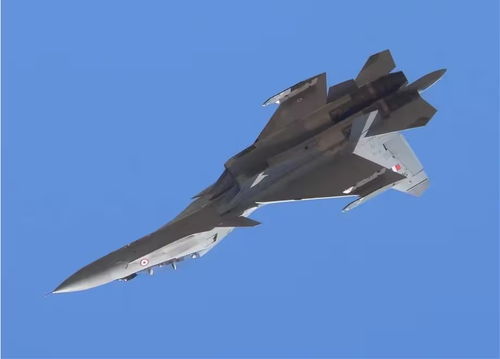
New Delhi plans to modernize 84 aircraft under a program worth $2.3 billion. One of the key elements will be the reduction of the radar cross-section (RCS).
The basic Su-30MKI with open air intakes, angular canards, and weapon pylons has a frontal RCS of 4-12 m².
These characteristics make the fighter noticeable to modern surveillance radars, including the Chinese JY-27V, which is capable of detecting such aircraft from a distance of 200-300 km. For comparison, the RCS of the stealthy F-35 is estimated in the range of 0.001-0.1 m².
The Indian defense laboratory DRDO has created a polyurethane RAM paint with magnetic functional fillers, optimized for the X- and S-bands.
The 50-100 kg coating is applied to areas with high RCS-engine nacelles, leading edges, canards, and pylon fairings. The modular design allows panels to be changed without damaging the airframe.
It is expected that the new technology will reduce the RCS of the Su-30MKI by 50-70%, to 1-3 m², which will reduce the detection range by approximately half-to 100-150 km.
Preliminary, the first modernized aircraft will appear in five years, and full operational readiness is expected by 2032.
Read more materials on the topic:
Never miss our newsAdd this site to your preferred sources to see us more oftenAdd on Google

















