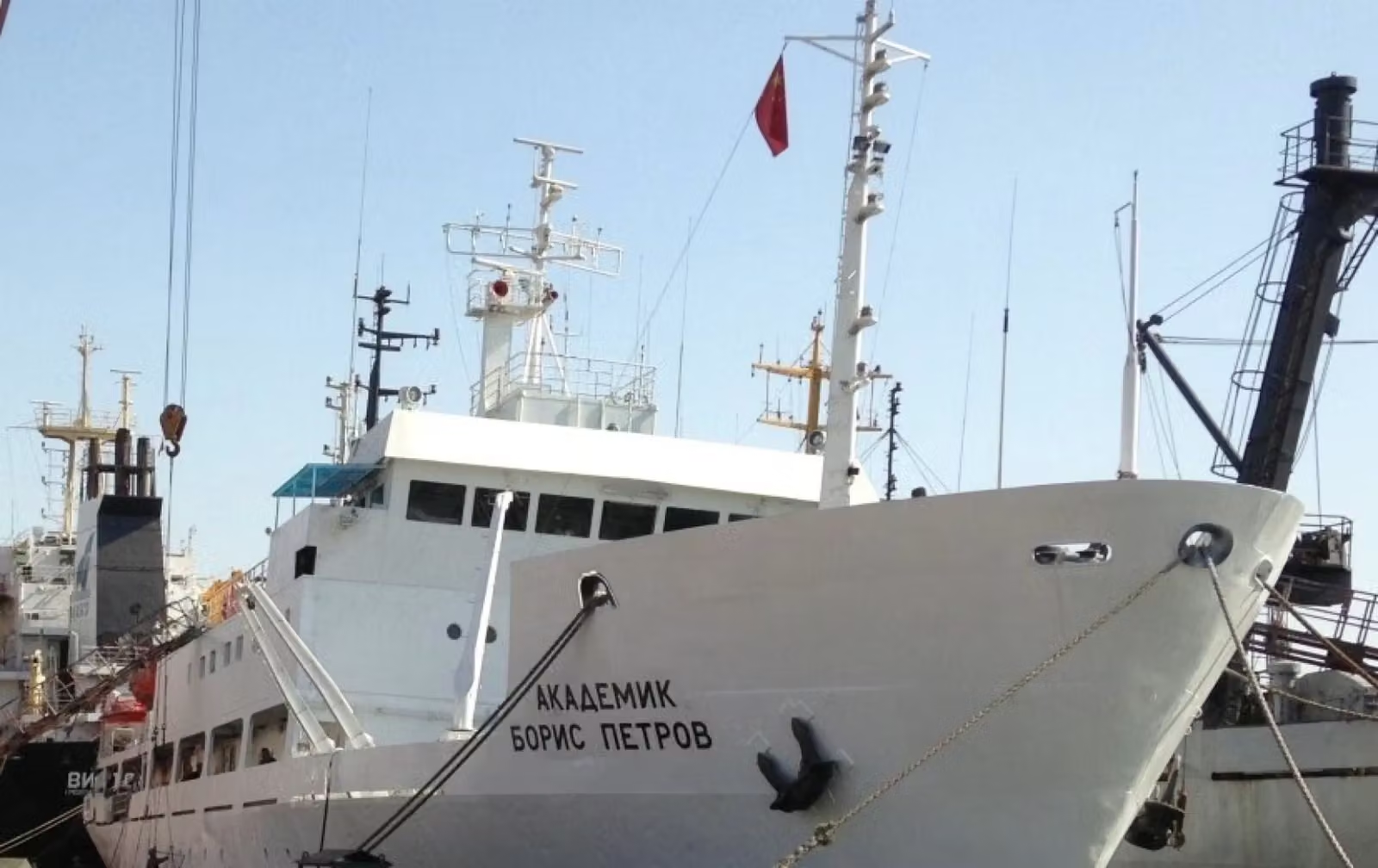
The research vessel (NIS) "Akademik Boris Petrov" left the port of Murmansk, heading to the North Atlantic to study the structure and seismic activity of the Mid-Atlantic Ridge. This was reported by the press service of the Shirshov Institute of Oceanology of the Russian Academy of Sciences.
The expedition, which starts in the Barents Sea, is led by Dmitry Ilyinsky, a senior researcher at the Institute of Oceanology. Scientists will study the structure of the upper part of the geological section and test new equipment. Then they will go to the Azores.
Microseismicity and the structure of the rift valley of the ridge will be studied using passive seismic observations. All measurements will be accompanied by magnetic surveying.
About the research vessel "Akademik Boris Petrov"
The ship was built in 1984 in Finland. The research vessel "Akademik Boris Petrov" is designed to study the hydrophysical features of the ocean, the structure of the ocean floor and atmospheric layers.
Characteristics of the research vessel:
- Displacement - 2689 t
- Length - 73.06 m
- Width - 14.7 m
- Board height - 7.3 m
- Draft - 4.5 m
- Speed - 13.5 knots
- Crew - 32 people
- Autonomy - 60 days
Read more on the topic:
- Modernized research vessel "Akademik M.A. Lavrentiev" returned to the port of Vladivostok from its first voyage
- The progress of the construction of the research vessel "Vikentiy Zaitsev" was inspected by Deputy Prime Minister Dmitry Patrushev
- The APU-2025 expedition on the research vessel "Professor Molchanov" made 56 stops
Never miss our newsAdd this site to your preferred sources to see us more oftenAdd on Google

















