In Russia, it is planned to conduct tests of a prototype photobioreactor, which is being developed to support the life of the crew at lunar and Martian bases. Testing with human participation is scheduled for the end of the summer. This was announced by the project manager Alexander Shaenko.
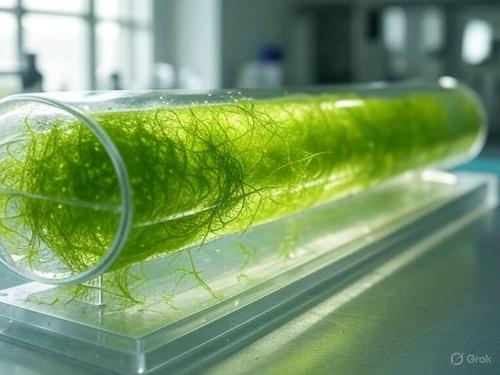
The photobioreactor is a system that uses microalgae to regenerate and purify water and air necessary for human life.
We are planning to be able to conduct the first tests with human participation this summer - for example, by the end of August. So that for about an hour a person breathes air that has passed through these microalgae.
Shaenko noted that in the first stage of testing, he himself will be the only participant. Currently, the project team has already assembled and started testing the air separation unit.
The prototype photobioreactor has demonstrated productivity significantly exceeding foreign counterparts.
Our installation is not the largest in terms of volume - we are now planning to make several hundred liters, but it is absolutely certain that the productivity of our approach is the highest in the world. We are able to cultivate about 18 grams of biomass per liter of water in the system per day, while our colleagues have this figure at the level of 1-5 g/l/day.
For space applications, the compactness and light weight of the device are important, which makes high specific productivity particularly relevant.
Our colleagues from abroad need about 500 liters of water to support the life of one person. We have a compact one, about 50 liters per person. According to calculations, it can be 35, but it is good to have a reserve.
The basis of the system is microalgae. In the future, the closed biosphere can be supplemented with other living organisms, including fish, which can become a source of food for humans. The system can operate for an unlimited time as long as there is an external source of energy. This is easy to provide on Earth, but problems may arise in space.
Microalgae do not need the entire spectrum of sunlight, they need a fairly small range. Therefore, there are suggestions that you can put a solar panel that converts the entire solar spectrum into electricity, and illuminate the algae with a narrowband LED, thereby increasing the efficiency of the system.
Earlier www1.ru reported that Russian cosmonauts on the ISS started research on the heart, plasma crystals and the ecology of the Earth.
Read materials on the topic:
The Plasma Crystal experiment is being conducted on the Russian segment of the ISS
Russian cosmonauts conducted a series of experiments on the ISS before returning home
The ISS is working on obtaining materials from lunar soil
Never miss our newsAdd this site to your preferred sources to see us more oftenAdd on Google

















