The Ministry of Education and Science spoke about the progress of the study related to the crash of the Russian Luna-25 spacecraft. A crater was discovered, formed by its fall and collision with the surface of the Moon. This helped to obtain some new data.
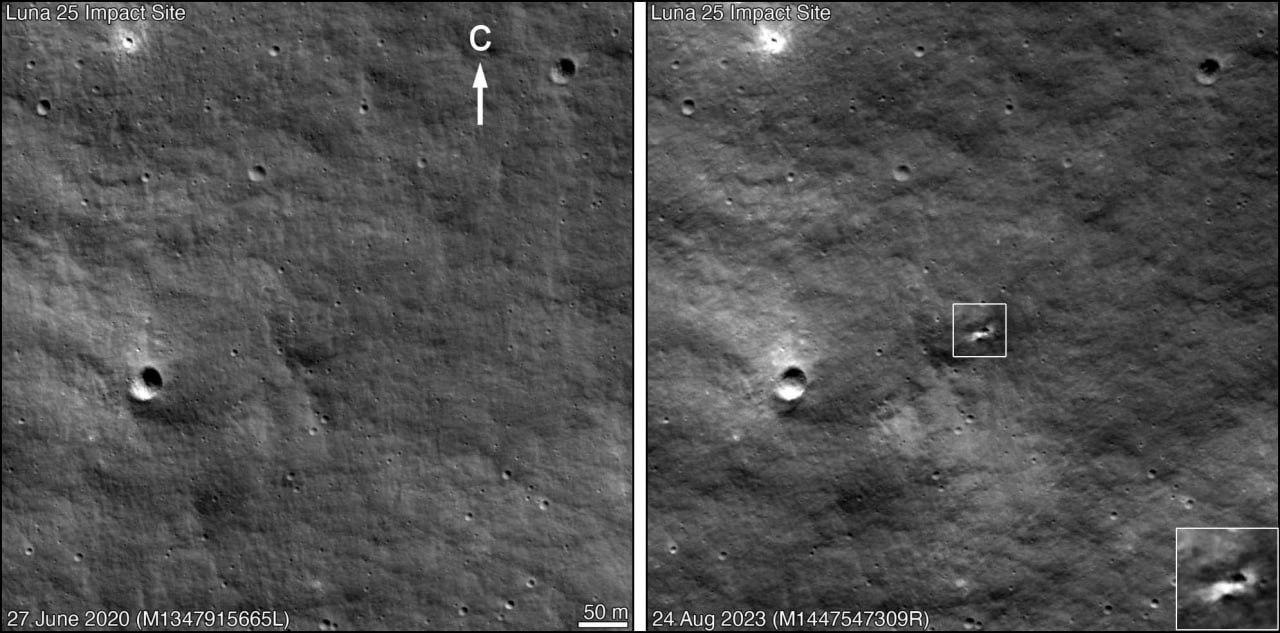
The find was made by employees of the Laboratory of Comparative Planetology of the Vernadsky Institute of Geochemistry and Analytical Chemistry of the Russian Academy of Sciences, together with colleagues from the Institute for Dynamics of Geospheres of the Russian Academy of Sciences and NPO Lavochkin, in images from the Lunar Reconnaissance Orbiter automatic station.
The photo shows that the new crater is located on the inner slope of a larger crater with a diameter of about 40 km. According to NPO Lavochkin, the landing unit of Luna-25 had a mass of 1605 kg when fueled. The spacecraft used some of its fuel before the impact, and according to expert estimates, its mass decreased to 600-1000 kg. According to the authors' calculations, the impact occurred at an angle of 45 degrees, and the maximum speed at impact was 1.7 km/s.
Luna-25
In 2023, Luna-25 became the first domestic spacecraft in almost fifty years to be sent from Russia to the Moon to study this satellite of the Earth.
The Luna-25 automatic station crashed without ever landing. A special commission investigated the incident. According to the results of its work, it became known that the accident wascaused by a new domestic angular velocity measurement unit "Bius-L", which is part of the station's onboard control system.
The device was designed at the Scientific and Production Center for Automation and Instrument Engineering named after Academician N. A. Pilyugin (NPCAAP) from completely Russian parts. It was responsible for determining the orientation of the station in space and its speed. Shortly before landing, the accelerometer units of Bius-L failed due to a possible"entry into one data array of commands with different priorities for their execution by the device".
But Luna-25 still managed to contribute to science. It took pictures from space and took measurements of the radiation background. Also, after entering the orbit of an artificial satellite of the Moon, the station photographed the southern polar crater Zeeman on the far side of the Moon, measured the flows of gamma rays and neutrons from the surface of the Moon, and obtained parameters of the lunar cosmic plasma and gas-dust exosphere in lunar orbit.
It is already known that Roscosmosintends to send two spacecraft to the Moon as part of the development of the Earth's satellite. The landing site for them will be determined by Luna-26, which is scheduled to launch in 2027. Luna-27a and Luna-27b will be assembled simultaneously, but launched separately. They will back each other up if something goes wrong, and the lunar program will not be delayed, as happened now.
Read materials on the topic:
Russian space truck "Progress MS-27" launched from Baikonur
Russian Gonets will begin to control the orbital groupings of the Sphere
The US has suspected Russia of launching space anti-satellite weapons
Never miss our newsAdd this site to your preferred sources to see us more oftenAdd on Google

















