Russian Armed Forces servicemen are "roughly modifying" heavy artillery with improvised materials. In an attempt to protect 2S19 "Msta-S" self-propelled howitzers from drone strikes, they are using wooden logs. This is written by military expert Dylan Malyasov in an article for Defence blog.
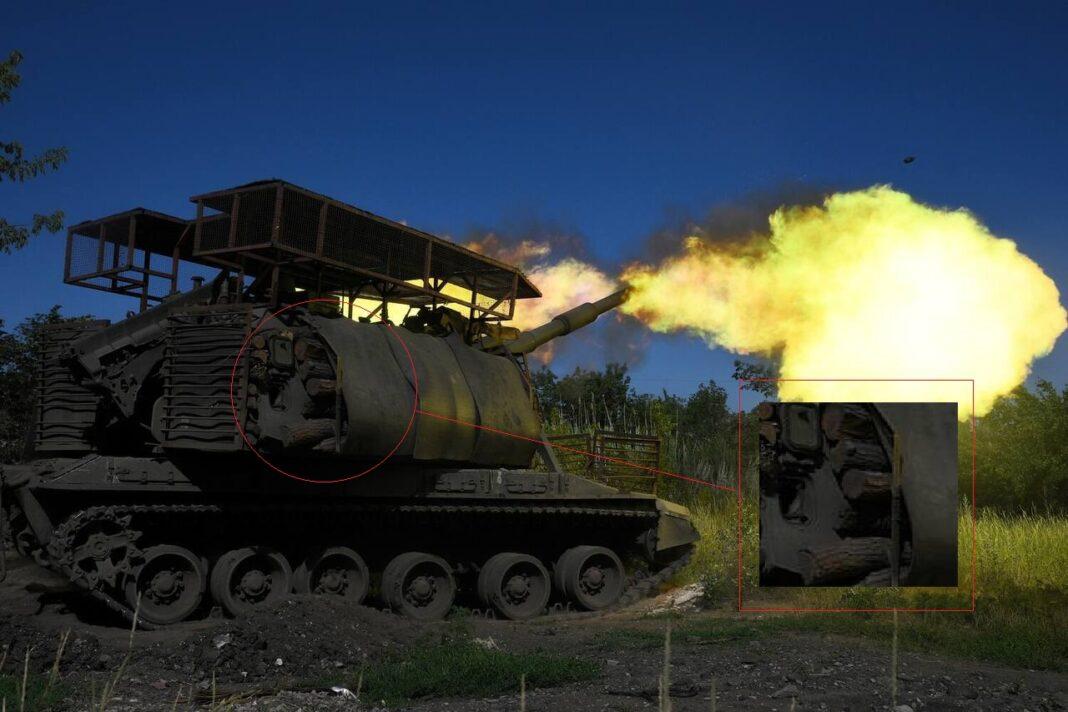
The side projection of the artillery is covered with logs connected by rubber sheets. A welded metal "barbecue" is installed on top. Similar designs are used for engineering vehicles or lightly armored vehicles.
The 152-mm 2S19 "Msta-S" is a crucial component of Russian artillery. Its high rate of fire plays an important role in supporting ground operations. Wood provides protection against shrapnel and small FPV drones, but is unlikely to withstand a direct hit from an anti-tank projectile or loitering munition.
Characteristics of 2S19 "Msta-S":
- Combat weight - 42,000 kg
- Armament - 2A64 gun, 152 mm caliber
- Rate of fire - 8 rounds per minute
- Range - up to 29 km
- Drive: V-84A diesel engine with turbocharging, 780 hp
- Maximum speed - up to 60 km/h
- Range - 500 km
Read also on the topic:
T-90M "Proryv" tanks changed beyond recognition: "dreads", "barbecue" and a lot of "Contact"
Rethinking modern combat: T-72B3M tanks equipped with new arc barbecues
Russian "Zmei Gorynych" received the "Tsar-barbecue" for the first time
Never miss our newsAdd this site to your preferred sources to see us more oftenAdd on Google