Researchers from Russia, Belarus, and China have created an ultraviolet microlaser with a diameter of only about two micrometers. Its size is comparable to that of a common bacterium. Despite its tiny dimensions, the device operates stably even at room temperature.
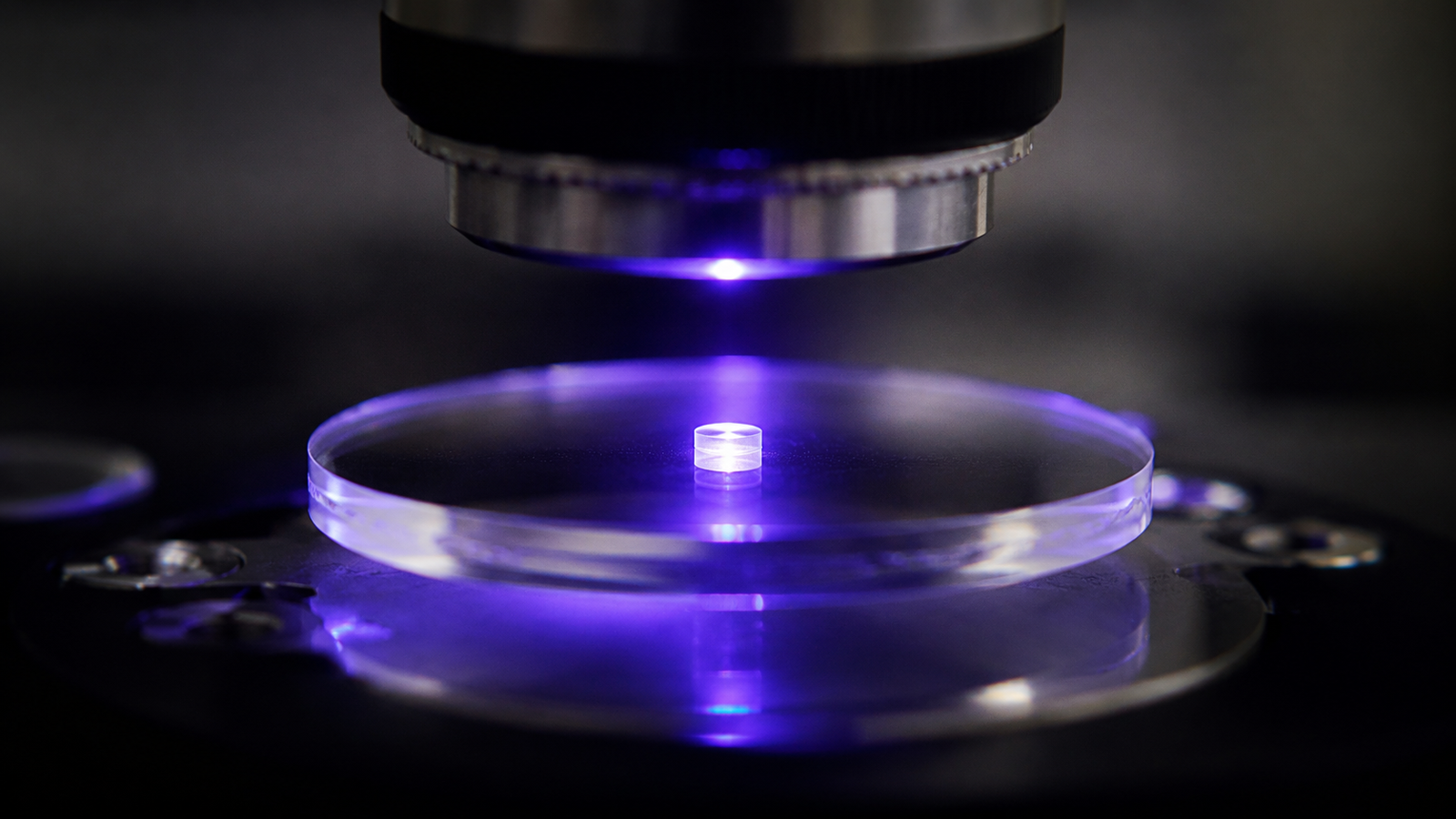
According to Eduard Moiseev, a senior researcher at the International Laboratory of Quantum Optoelectronics at HSE University, the development paves the way for the creation of compact photonic chips. Such devices can be used in spectroscopy, biosensors, and communication systems operating in the ultraviolet range.
Physicists have been trying for many years to create lasers for miniature devices and integrated circuits. The problem is that as the device shrinks, it becomes increasingly difficult to contain light within it. In a device that is too small, light begins to leak out quickly.
Scientists solved this problem using the "whispering gallery" effect and a special interlayer between the sapphire and the active layers of the device. This interlayer gradually changes its composition, relieves internal material stress, and prevents radiation from escaping quickly. Thanks to this, the laser remains stable even at a size of only a few micrometers.
In terms of operating parameters, the development is comparable to the best examples of other compact lasers, but the diameter of the emitter itself is only two micrometers.
The small size will allow such lasers to be integrated into compact devices and communication systems. According to the researchers, this will significantly expand the application of deep ultraviolet in science and industry.
Read more on the topic:
Never miss our newsAdd this site to your preferred sources to see us more oftenAdd on Google