Translated with AI from the Russian original.
Russia has outlined the main stages of its lunar program for the next decade. In 2035, the "Luna-31" spacecraft is planned to be sent to the Moon to explore unique and little-studied regions of Earth's satellite. The updated plans were presented by Lev Zelenyi, scientific director of the Space Research Institute of the Russian Academy of Sciences.
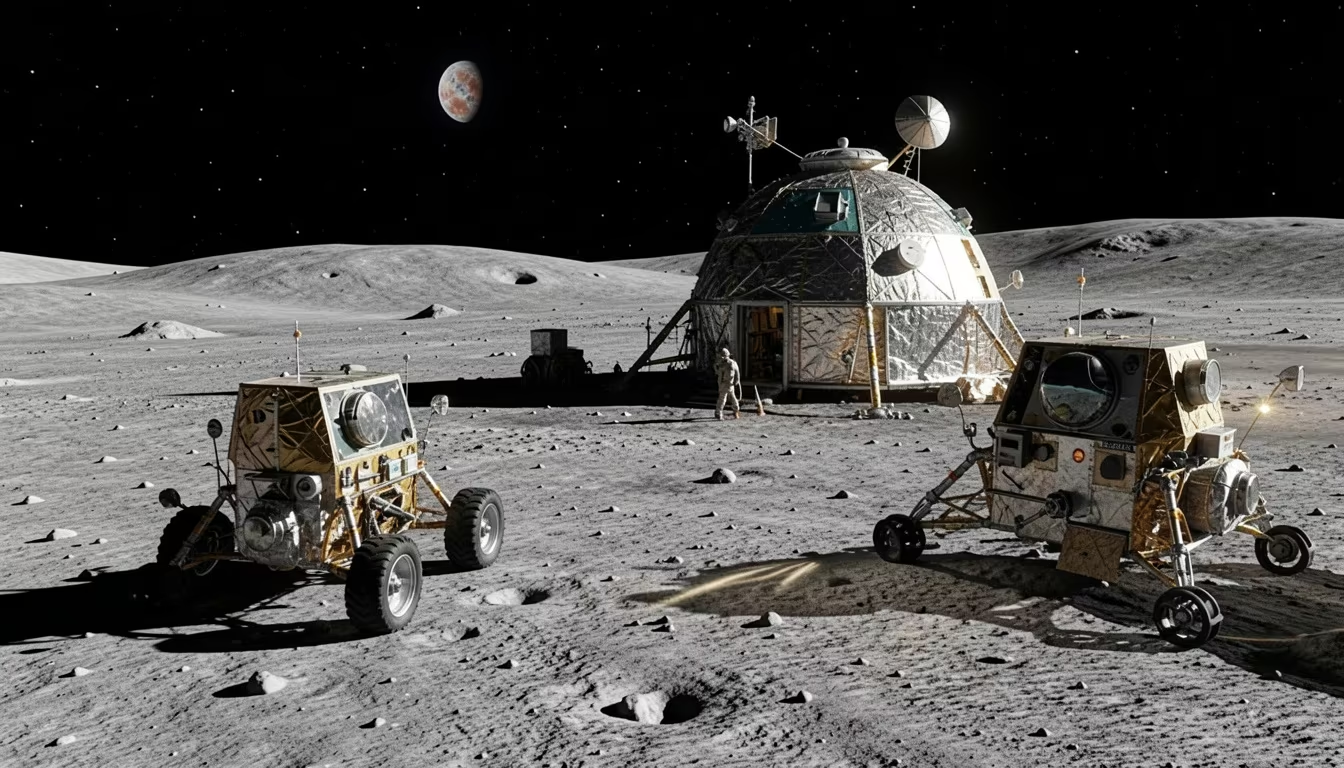
According to the presented materials, the program's development will continue with a series of automatic missions. In 2033, the launch of the heavy lunar rover "Luna-30" is planned, which will study the composition of lunar soil along a route near the polar regions. The next stage will be the "Luna-31" mission with a lander for operations in areas of particular scientific interest.
Another expedition, scheduled for 2036, involves sending a lander for astronomical research, resource prospecting, and biological experiments.
Before these projects are implemented, Russia expects to complete earlier missions. The orbital spacecraft "Luna-26" is intended to lay the groundwork for further study of the satellite from near-lunar orbit. During its first year of operation, it will be at an altitude of 60–80 kilometers, after which it will move to an orbit of 150–200 kilometers. In addition to scientific observations, the spacecraft will be used to relay data from future landing stations.
The "Luna-27" program aims to develop high-precision landing technologies and conduct research in the Moon's circumpolar regions, which are considered promising sites for future long-term expeditions.
In parallel, international cooperation in space exploration continues. Roscosmos and the China National Space Administration previously agreed on joint work on a power plant project for the International Lunar Research Station. This infrastructure is expected to enable fundamental research and test technologies for long-term autonomous operation on the Moon, with a view to subsequent human presence.
Read more on the topic:
Never miss our newsAdd this site to your preferred sources to see us more oftenAdd on Google

















