Physicists from Russia and Armenia tested the compact SAFT telescope and showed that even a small system with lenses only 25 cm in diameter can detect traces of ultra-high-energy cosmic rays. The development was tested by scientists from the Skobeltsyn Institute of Nuclear Physics, MSU, and the Alikhanyan National Science Laboratory (Yerevan Physics Institute).
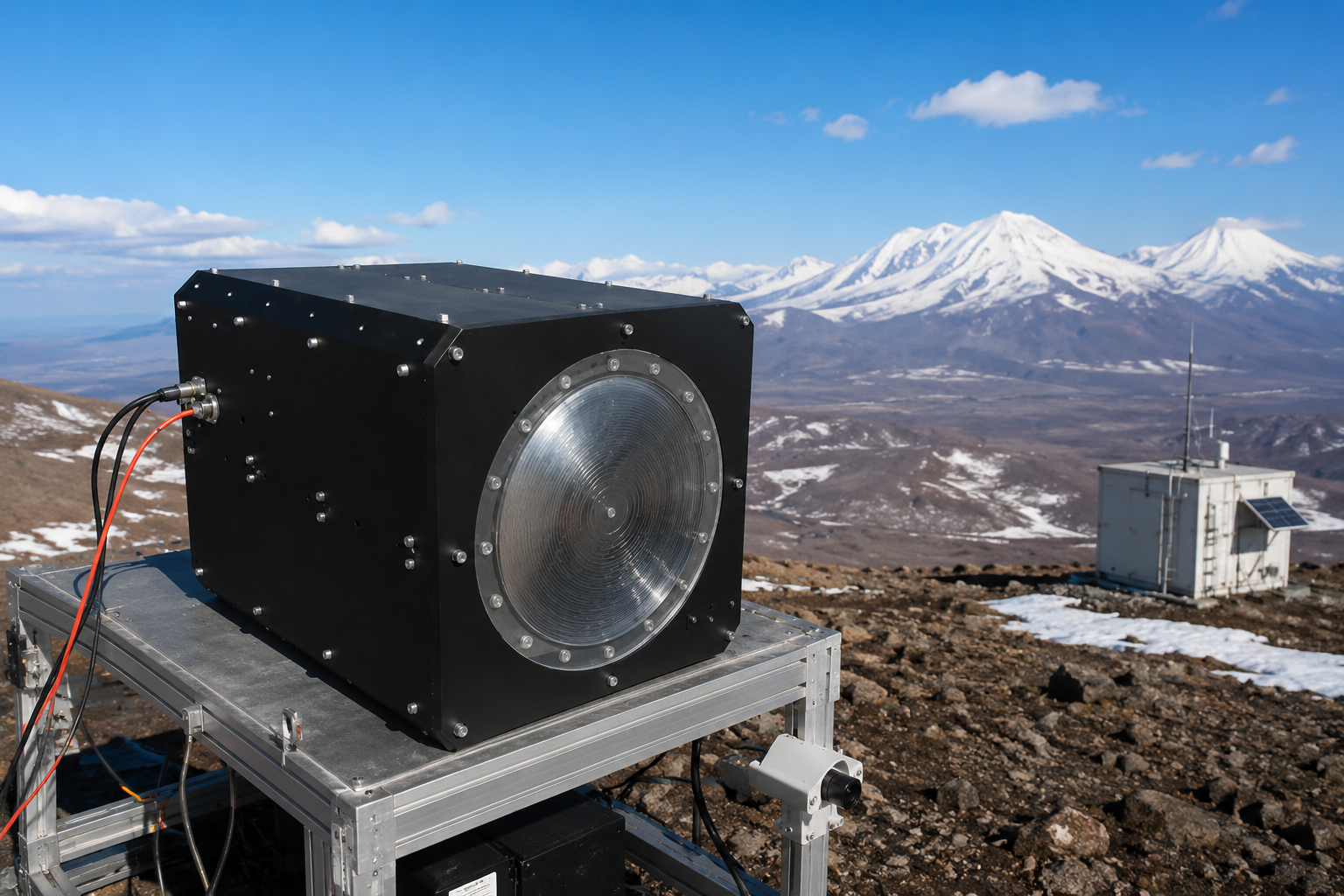
The experiment took place at the Aragats high-altitude station in Armenia, at an altitude of 3200 meters above sea level.
We are talking about ultra-high-energy cosmic rays. When such a particle enters the Earth's atmosphere and collides with gas atoms, a whole cascade of secondary particles arises – a so-called extensive air shower.
The SAFT telescope detects not the particles themselves directly, but the faint ultraviolet glow of nitrogen molecules. This appears when such a particle cascade passes through the atmosphere.
Typically, large installations are used for such observations. For example, the American Telescope Array operates with mirrors covering an area of about 10 m².
The Russian-Armenian group led by Pavel Klimov took a different approach: the scientists made the system more compact and lighter. Instead of huge mirrors, they used Fresnel lenses made of a special polymer that transmits ultraviolet light.
This approach allows for the creation of mobile detectors. They can be used for calibrating ground-based complexes, as well as on board orbital stations.
The main difficulty of a small telescope is the weak signal. Useful flashes are almost drowned out by noise, so distinguishing a real event from interference is very difficult.
To solve this problem, the researchers applied deep machine learning. Convolutional neural networks helped to separate real atmospheric flashes from false signals that occur when protons directly hit the telescope's photodetector.
According to the authors of the work, the system was able to do this with 100% accuracy. As a result, automatic processing reliably identified more than 15 events with energies in the range of 10¹⁷–10¹⁸ eV. This corresponds to theoretical expectations.
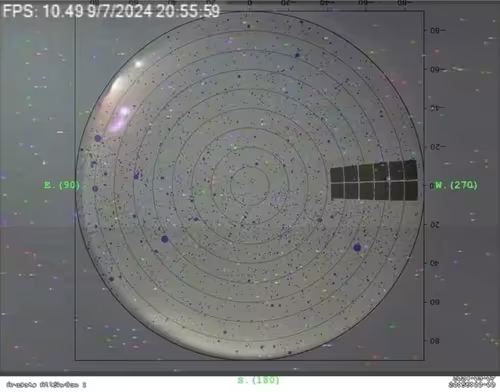
The tests were an important step for future space missions, including the ERA – Extreme Relativistic Astrophysics project. Scientists also confirmed the operability of the electronics and optical scheme, which were originally developed for the Lomonosov series satellites and the UV-atmosphere orbital detector.
If such instruments are placed in space, they will be able to observe vast areas of the Earth's atmosphere. In fact, the entire planet can become a giant detector for searching for the most energetic particles in the Universe.
In the future, researchers plan to integrate such small telescopes into the Taiga-100 observatory currently under construction in Siberia. There, compact optical modules will work together with Cherenkov and scintillation arrays. Such a hybrid system will help to more accurately study particles that arrive from the most powerful cosmic sources – supermassive black holes and the nuclei of distant galaxies.
Read more on the topic:
Never miss our newsAdd this site to your preferred sources to see us more oftenAdd on Google

















