Translated with AI from the Russian original.
Scientists from Perm Polytechnic University, together with colleagues from the Moscow Advanced Studies Center, Moscow State University, the Russian Quantum Center, and South Korea's Sungkyunkwan University, have created the world's first compact fiber-optic device with a metalens. It fits in the palm of your hand and can detect what is invisible to the naked eye: traces of microplastics or early signs of a tumor. The development was reported by the press service of the Russian Ministry of Education and Science.
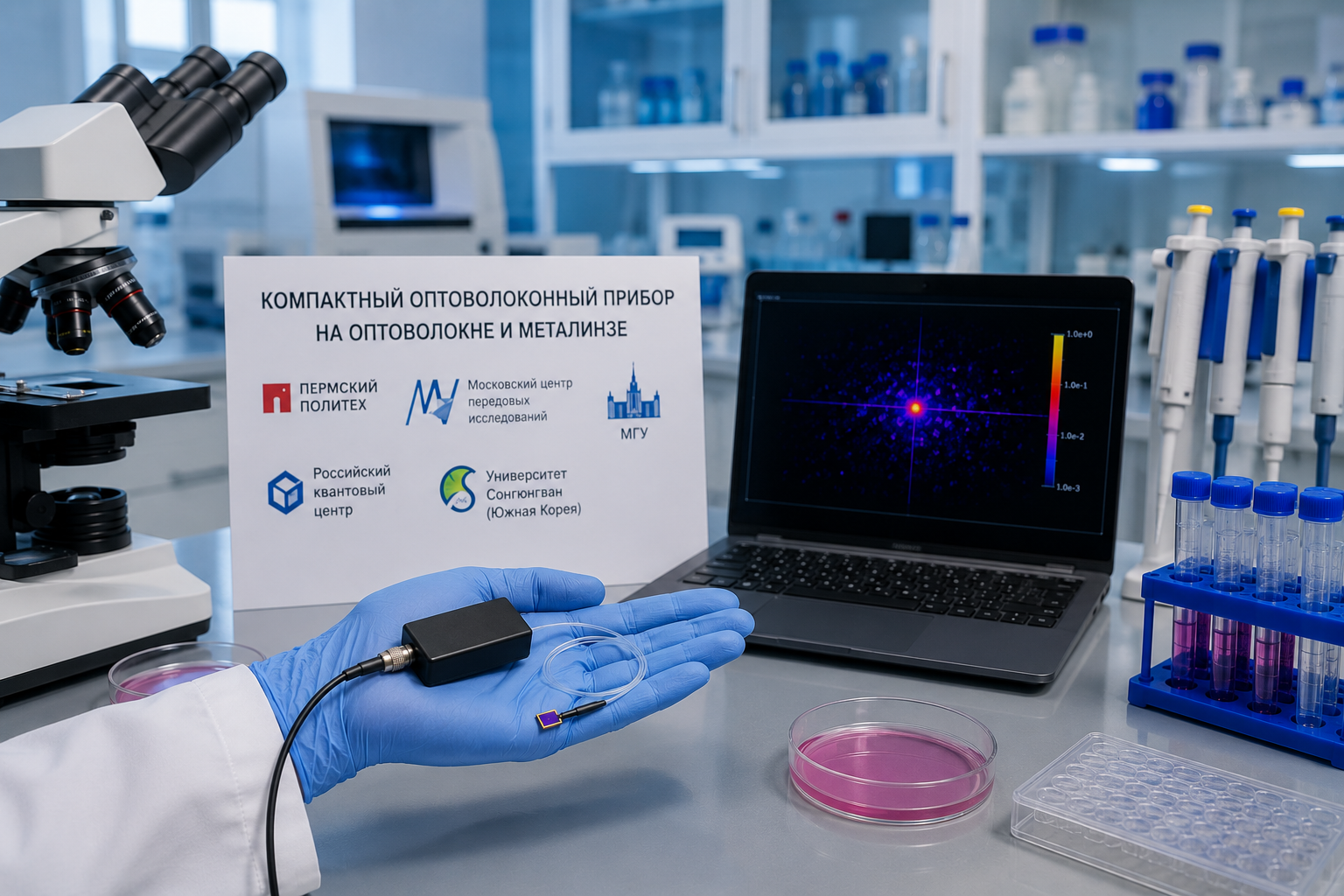
The development solves an important problem in medicine and ecology, as dangerous nanoparticles are difficult to detect in time. This could be microplastics, which are found even in human blood and are associated with inflammation and cancer risk, or biomarkers indicating a tumor even before it is visible on a tomograph.
Currently, such particles are sought using complex laboratory equipment costing millions of rubles. But while the sample is being transported to the laboratory, particles can settle, clump together, or break down, and cancer markers can decompose in about half an hour. This can distort the result.
The new device is designed differently. It operates on a fiber-optic cable, similar to those used for the internet. A metalens is applied to its end – an ultra-thin plate made of millions of silicon "antennas" that control light.
Before analysis, particles are stained with a special substance so that they glow under a laser. The beam passes through the cable, the metalens compresses it to a point, and the particles emit a return signal. This signal is transmitted back to the computer by the cable.
The main advantage of the device is that it fits completely in the palm of your hand, does not require complex setup, and is resistant to vibrations.
To test the device, scientists conducted a series of experiments. They used glowing plastic particles of various sizes, as well as individual protein molecules. According to Alexander Syuy, Professor of the Department of General Physics at Perm Polytechnic University, the device confidently detected all these objects. It coped even at ultra-low concentrations, when only a few hundred million particles were present per liter of water or blood.
The key solution was the thickness of the optical fiber – 50 microns. This is about half the thickness of a human hair. The research results are published in the scientific journal Advanced Optical Materials.
Read more on the topic:
- Cancer drug can now be delivered directly to the tumor thanks to a new biocomposite
- Cancer proposed to be treated without surgery and expensive metals: a gold replacement found
- A new vaccine for colorectal cancer has been approved for use in Russia: the drug forces the immune system to attack the tumor
Never miss our newsAdd this site to your preferred sources to see us more oftenAdd on Google

















