Tumors near nerves and blood vessels are among the most dangerous, as they are difficult to remove without the risk of blindness or stroke. But there is a method that works without incisions – the tumor is literally "heated" from within. Now, it may have a more accessible and precise version. Scientists from Perm Polytechnic and the Moscow Center for Advanced Research, along with colleagues from the UAE and France, have found a replacement for expensive gold nanoparticles.
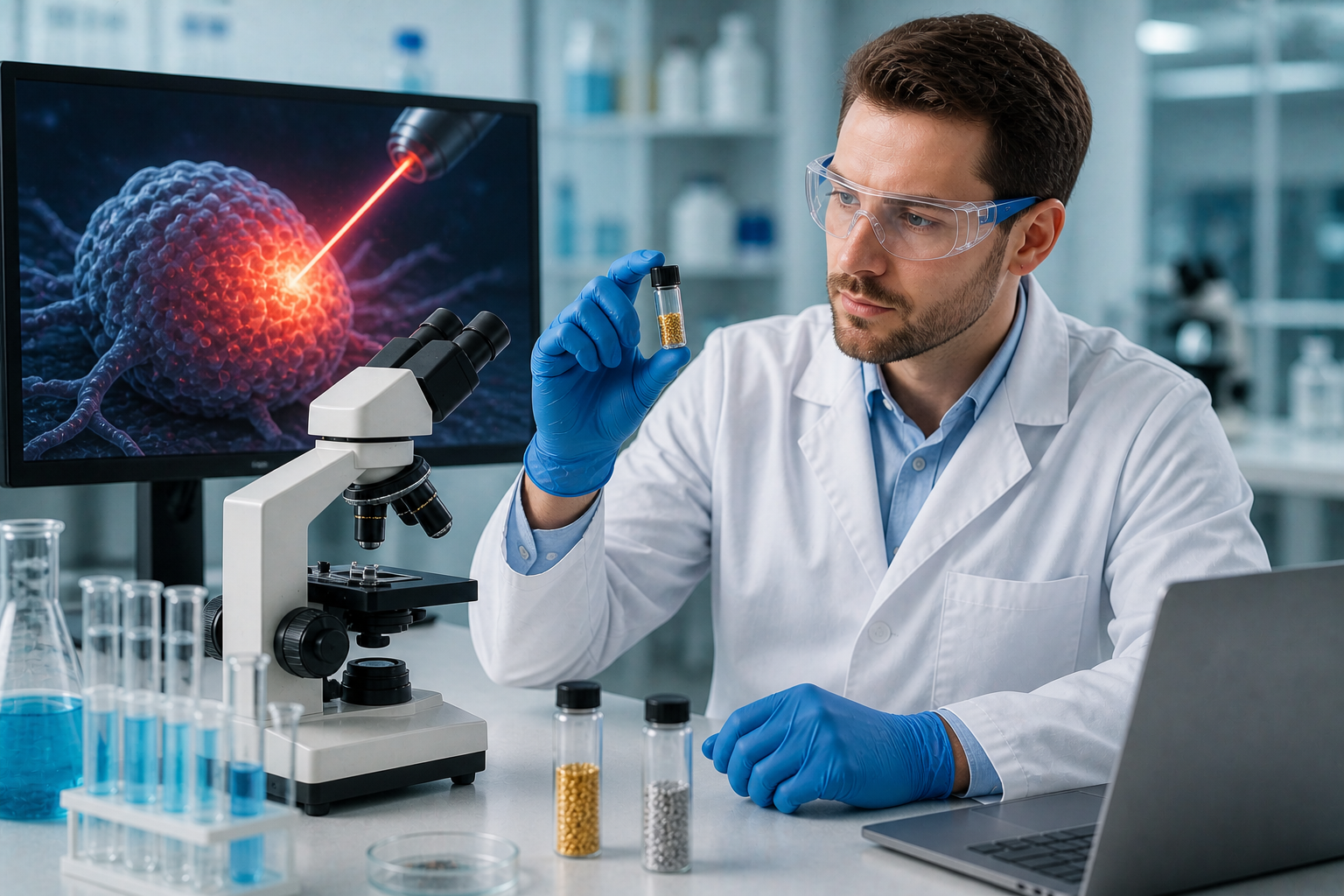
This refers to photothermal therapy. Tiny nanoparticles are injected into the tumor, and then irradiated with a laser. The particles absorb light, heat up, and destroy cancer cells from within, without damaging healthy tissues. However, conventional materials – gold and silver – have serious drawbacks: they are expensive, can be toxic, and do not allow for flexible heat control.
Therefore, Russian scientists, together with foreign colleagues, for the first time created spherical nanoparticles from tungsten and palladium compounds – diselenides. Such particles are synthesized in water without harmful reagents, do not require toxic stabilizers, and do not clump together due to their own charge. In addition, they are cheaper than gold analogues.
The main difference is in how they heat up. Tungsten-based particles heat strictly at a specific wavelength – about 770 nm. If the laser settings are slightly changed, the heating almost stops. Palladium-based particles, on the contrary, work effectively in a wide range – from 650 to 950 nm. This makes it possible to evenly heat large or deep neoplasms. In fact, the doctor gets a choice: to use pinpoint or "wide" heating depending on the situation.
In laboratory experiments, palladium diselenide showed an efficiency of converting laser energy into heat up to 81%, tungsten diselenide – about 71%. This is comparable to the best gold-based samples, which yield approximately 70–80%, but are more expensive and have more limitations.
The photothermal therapy method is already being applied: abroad, it is being tested for prostate and lung cancer, and in Russia, it is used to treat skin melanoma and eye tumors. The study was published in the journal Applied Surface Science.
Read more on the topic:
Never miss our newsAdd this site to your preferred sources to see us more oftenAdd on Google