Specialists from the Moscow Higher Combined Arms Command School of the Russian Ministry of Defense have patented a multifunctional ground robotic complex (GRC) with a neural network control system. TASS reviewed the patent on March 17. A key feature of the development is autonomy: the neural network is capable of performing the task independently of the operator. When communication is suppressed by enemy electronic warfare equipment, the complex automatically returns to its starting position, rather than losing control. The platform is designed to operate in urban conditions and off-road, day and night, in all weather and temperature conditions, according to the patent description.
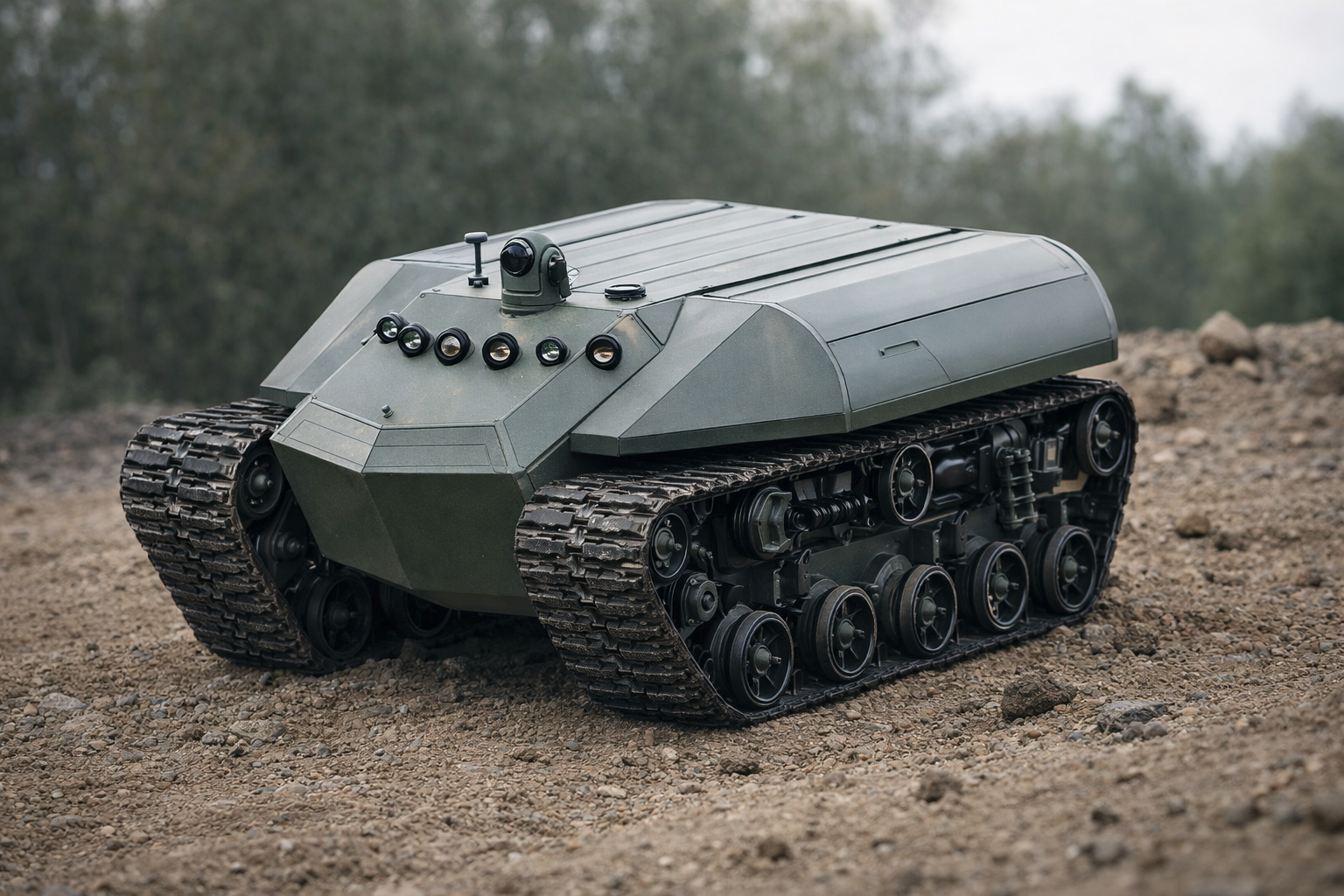
Modular Architecture of the Ground Drone: From Reconnaissance to Mining
The complex is built on a universal tracked platform with quickly replaceable modules. The basic configuration includes a central computer, a navigation and orientation system, an FPV system, and a reconnaissance and combat module. Changing modules allows switching the drone between tasks without replacing the entire machine.
The main tasks according to the patent are military and artillery reconnaissance, laying anti-tank mines of the TM-62 type, and fire support for units. The authors emphasize that modularity opens up the possibility of expanding functions by installing other combat or auxiliary modules.
Specifications of the Ground Drone
- Chassis type: universal modular tracked platform
- Control system: neural network, with autonomous mode
- Resistance to electronic warfare: when communication is suppressed - automatic return to the starting position
- Operating conditions: day/night, any weather and temperature conditions, city, off-road
- Main tasks: reconnaissance, mining (TM-62), fire support
- Construction: modular, with quickly replaceable modules
- Developer: Moscow Higher Combined Arms Command School of the Russian Ministry of Defense
- Status: patent registered
Autonomy as a Response to Electronic Warfare
Ground robotic complexes with remote control are vulnerable to electronic warfare equipment - this was one of the main lessons learned from the use of drones in the armed conflict zone. Neural network control, capable of operating without a communication channel with the operator, removes this vulnerability. How much such autonomy is implemented in serial Russian GRCs has not been officially confirmed: the patent records a design solution, not a fact of production.
The appearance of a patent from a structure of the Ministry of Defense is a signal that autonomous ground platforms are moving from the category of experimental to the category of systemic solutions of the state defense order. The modularity of the design reduces the cost of adaptation to specific tasks and reduces the logistical burden - one platform replaces several highly specialized machines.
Read more materials on the topic:
- New Uran-3 assault drone with mine trawl and machine gun created in Russia
- Small "Solntsepek": Roy flamethrower drone on "Torpedo" began to be used by the military
- Promising flamethrower "Skoliya" installed on the ground robot "Courier"
Never miss our newsAdd this site to your preferred sources to see us more oftenAdd on Google