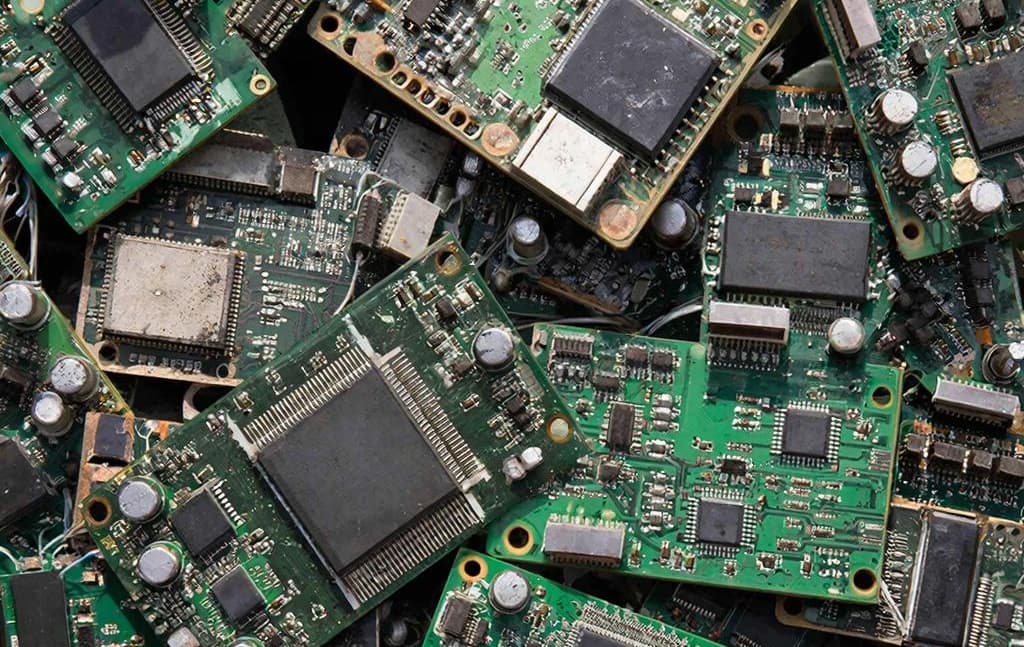
Russian and Chinese scientists have developed two-dimensional organic frameworks with built-in "nanolows" to extract up to 99.2% of gold from electronic waste. This was reported by the Ministry of Education and Science of the Russian Federation.
The project involved representatives of the Research School of Chemical and Biomedical Technologies of Tomsk Polytechnic University (TPU), Zhejiang University of Science and Technology, and the Ningbo Institute of Materials Technology and Engineering.
The press service of the ministry explained that the proposed method is much more efficient and environmentally friendly than traditional methods of extracting precious metal.
"Nanolows" capture gold ions and, when irradiated with visible light, reduce them to pure metal.
We are talking about the use of covalent organic frameworks (COF) and chemical "sponges" with "built-in" vinylazole bridges. One of the authors of the study from TPU, Raul Rodriguez, said that the new method allows extracting gold even at a low concentration of metal. In addition, it is possible to work with impurities, including solutions of gold, copper and nickel.
These COFs can be used repeatedly: the efficiency is maintained for five sorption-desorption cycles.
According to scientists' estimates, by 2030, the world's reserves of electronic waste will increase to 82 million tons. The extraction of precious metals is one of the important tasks for their disposal.
Read more materials on the topic:
- Cooling of microchips for electronics accelerated 20 times by TPU scientists
- Electronics and auto parts may rise in price in Russia by 30%
- No one will make domestic chips for military electronics: the construction of the Karat microchip factory was buried
Never miss our newsAdd this site to your preferred sources to see us more oftenAdd on Google

















