Scientists at ITMO University have developed the Cellpose+ program, which significantly speeds up the process of designing materials for regenerative medicine. The tool expands the capabilities of the popular Cellpose framework, adding automatic collection of statistics on the shape, size, and other characteristics of cells. This allows for faster analysis of the compatibility of biomaterials with human tissues, which is crucial for creating medical implants, healing coatings, and drug delivery systems.
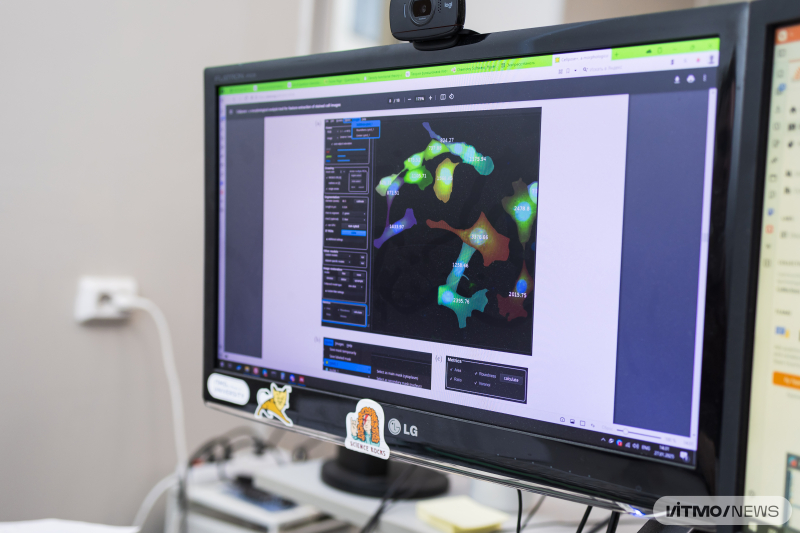
Researchers usually have to manually process hundreds of cell images, which takes several days. The Cellpose+ program reduces this process to a few minutes thanks to machine learning algorithms. It not only separates cells in images but also immediately analyzes their key parameters, including density, area, shape, location of nuclei, and Voronoi entropy level, which shows how ordered the cellular structure is.
Previously, to collect statistical data, it was necessary to unload images from Cellpose and process them in another program or manually. Now, both of these functions are combined in one tool. First, a neural network works with the images. It is trained to segment cells on the Cellpose library of images. After that, our program works with the processed images. Data is collected and classified using feature extraction and analysis algorithms. Then, the results are uploaded to separate files according to the specified characteristics of the cells, with which the scientist can already work. At each stage of Cellpose+ operation, a person can also control the image processing process to minimize the number of errors.
Currently, the developers are testing the program on biodegradable polymers - polyhydroxyalkanoates, which can be used to create medical implants. In the future, the technology can be adapted for other tasks, such as assessing the effectiveness of anti-cancer therapy, searching for abnormal cells in diagnostics, or studying the mechanisms of cell division.for
The program code is inopen access, which allows scientists around the world to use it in their research.
Read more materials on the topic:
New technology for detecting mines and explosive objects is being developed at TSU
Biomaterial for the treatment of osteoporosis developed by scientists at Tomsk State University
Software from Perm scientists will speed up the testing of gas turbine engines by 1.5 times