A solar flare of class X1.2, recorded the night before on June 18, will not lead to significant consequences for the Earth. This was reported by the Solar Astronomy Laboratory of the Institute for Space Research (IKI) and the Institute of Solar-Terrestrial Physics (ISZF).
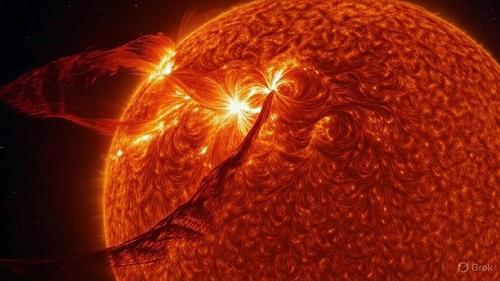
According to preliminary data, the flare occurred at a great depth in the lower layers of the solar atmosphere and was almost completely shielded by powerful magnetic fields located above. Observations from space coronagraphs did not reveal any coronal mass ejections directed towards the Earth. Although minor traces of plasma ejection were recorded on the eastern edge of the Sun, they are of weak intensity and move in a direction far from the Earth's orbit.
This powerful flare will not cause magnetic storms or radio interference. Experts will monitor the situation and, if additional data appear in the coming days, they will be published to clarify the picture of what is happening.
Earlier www1.ru reported that the second powerful flare occurred on the Sun on June 16.
Read materials on the topic:
Luch satellites will reach a new level: communication is now at an altitude of up to 20,000 km
The domestic 5G satellite communication system was tested for the first time in Russia
Never miss our newsAdd this site to your preferred sources to see us more oftenAdd on Google