Translated with AI from the Russian original.
A flare of the penultimate power class M occurred on the Sun on Saturday night, according to the Laboratory of Solar Astronomy of the IKI RAN and ISZF SB RAS. It was accompanied by a large ejection of plasma, partially directed towards Earth.
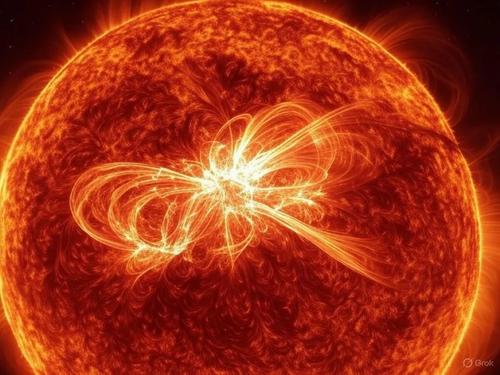
The M8.2 class flare was generated by a group of spots with the beautiful number 4100. It is located on the Sun-Earth line, so the ejection is very likely to reach Earth in a few days.
Solar flares, depending on the power of X-ray radiation, are divided into five classes: A, B, C, M, and X. The minimum class A0.0 corresponds to a radiation power at the Earth's orbit of 10 nanowatts per square meter. When moving to the next letter, the power increases by 10 times. Flares are usually accompanied by ejections of solar plasma, the clouds of which, reaching the Earth, can provoke magnetic storms.
Read more materials on the topic:
The most powerful class X solar flare recorded by Russian scientists on Sunday, May 25
A mysterious object larger than Earth, resembling a bird or a spacecraft, was spotted above the Sun
The lull is over: the number and power of flares on the Sun are frighteningly increasing
Never miss our newsAdd this site to your preferred sources to see us more oftenAdd on Google

















