Translated with AI from the Russian original.
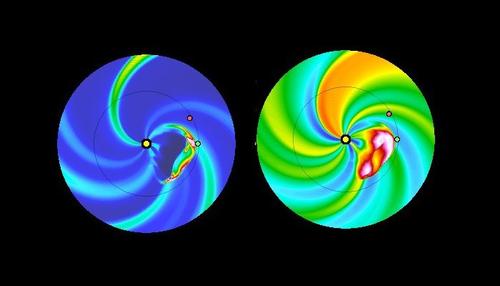
A major coronal mass ejection from the Sun is expected to arrive today. This was reported by the Space Research Institute of the Russian Academy of Sciences and the Institute of Solar-Terrestrial Physics of the Siberian Branch of the Russian Academy of Sciences.

The ejection was recorded on March 21 at approximately 19:00 Moscow time. Typically, plasma clouds reach Earth in about 48 hours. However, due to extremely high gas velocities, the transit time has been reduced to 32 hours, meaning that the expected arrival of the cloud on Earth will be today, around 19:00 Moscow time.
The front of the ejection has not yet reached Earth, but its arrival is expected within the next 24 hours. At the same time, the possibility of avoiding the cloud is considered impossible, since its size when reaching Earth's orbit is from 70 to 100 million kilometers.
The parameters of the solar wind are now as favorable as possible for auroras, creating the best conditions for their observation. However, plasma clouds have their own patterns, and their impact may be stronger than expected.
Read materials on the topic:
Russians observed the Northern Lights at night due to a powerful geomagnetic storm
Muscovites will be able to see the Northern Lights on the night of March 24
Cosmonaut Wagner showed footage of the first Northern Lights in 2025
Never miss our newsAdd this site to your preferred sources to see us more oftenAdd on Google

















