Currently, satellites at the Lagrange point L1, located 1.5 million km from Earth towards the Sun, have not recorded the expected arrival of the plasma cloud from the March 2 flare.
Short-term fluctuations in the magnetic field, noted last night, are attributed by experts to natural variations in the geomagnetosphere, rather than external influences. The intensity of these changes turned out to be 2-3 times weaker than the predicted values.
The likely reason for the discrepancy with the forecast was the initial angle of the ejection, directed away from the Earth's orbit. An alternative version suggests an error in calculating the speed of the plasma movement. It is impossible to experimentally verify these hypotheses - we can only wait. If disturbances do not appear by 12-13 hours Moscow time, the threat of geomagnetic consequences will be excluded.
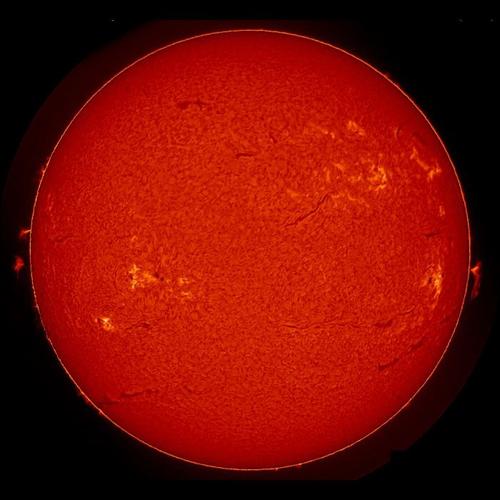
Solar activity remains moderate so far. The main attention of scientists is focused on active region 4012, which is gradually shifting to the central meridian of the Sun. In the next 48 hours, the probability of M-class flares here is estimated as high. The impact of coronal holes on the Earth's magnetosphere during the current week is unlikely.
Monitoring space weather is critical for protecting satellite systems, power grids, and navigation equipment. Powerful plasma ejections can disable the electronics of orbital vehicles and create radio interference. Predicting such events allows minimizing risks to technological infrastructure and the health of astronauts on the ISS. Data from observatories at point L1 serve as an "early warning," giving up to 60 minutes to prepare for geomagnetic storms.
Read materials on the topic:
Two powerful flares occurred on the Sun on Monday
Never miss our newsAdd this site to your preferred sources to see us more oftenAdd on Google