Translated with AI from the Russian original.
The T-14 "Armata" tank has unique capabilities due to its effective dynamic protection system. It allows solving the tasks of defeating the enemy, said Konstantin Sivkov, Deputy President of the Russian Academy of Rocket and Artillery Sciences for Information Policy, a military expert.
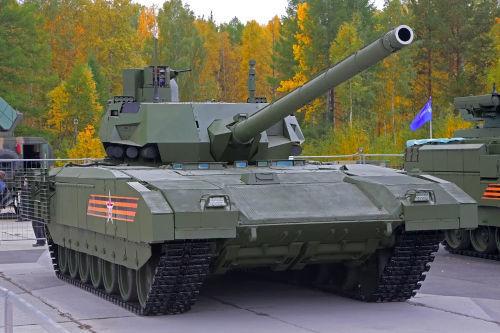
According to him, thanks to this, the Russian combat vehicle is unmatched in the world today. He recalled that the "Armata" is also equipped with a highly effective active protection system that allows intercepting armor-piercing projectiles.
The fire control system allows calculating the trajectory of projectiles and delivering counterstrikes quickly and efficiently against the artillery system that fired the projectiles. It is guaranteed to destroy the artillery system.
Also, the T-14 is focused on increasing the combat capabilities of promising formations in modern conditions by uniting all participants in combat operations into a single network and achieving infocommunication superiority.
The firing range of the T-14 reaches 8 km, and for tanks and artillery systems - 15-20 km.
Earlier www1.ru reported that 95% of Russia's strategic forces will be equipped with modern weapons.
Read materials on the topic:
Unique footage of the night work of the Akatsiya self-propelled gun: the hammer of the Russian army
Russian drone with flamethrower "Gorynych 2.0" is eager to fight: they found a way to deal with Starlink
The newest Titan rifle was developed for the Russian special forces: you have not seen such accuracy yet
Never miss our newsAdd this site to your preferred sources to see us more oftenAdd on Google

















