Scientists from the Department of "Physical and Technical Problems of Quantum Metrology" of NRNU MEPhI have started implementing a project on laser cooling of thorium-232 anions. As "Pervy Tekhnichesky" was informed by MEPhI, the team received a grant of 100 million rubles for these purposes. The funds were allocated within the framework of the "Priority-2030" program for three years.
Cooling negative ions (anions) to ultralow temperatures is one of the most challenging tasks in modern physics. The binding energy of an extra electron in anions is so small that laser exposure easily destroys this fragile balance. However, it is ultracold anions that can become key elements for quantum computers and ultra-precise clocks.
Among many elements, thorium anions (Th⁻) are considered one of the most promising candidates for laser cooling. It has been experimentally established that the lifetime of one of the key excited states of Th⁻ is only 30 microseconds – this is three times shorter than previous calculations, which makes it extremely attractive for the technology. The thorium-232 isotope lacks a hyperfine structure, which simplifies the laser scheme.
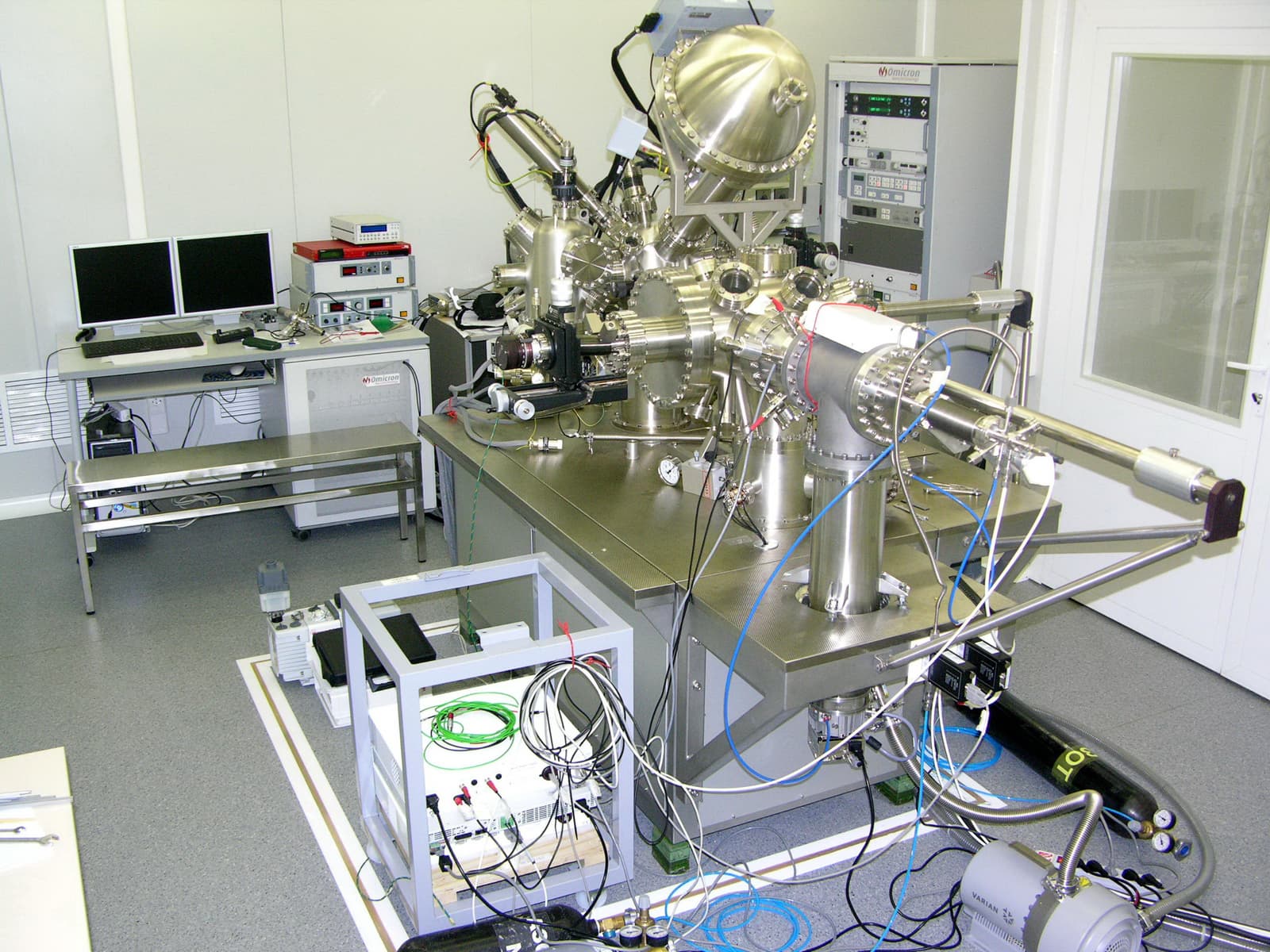
The project aims to create an experimental setup for direct laser cooling of thorium-232 anions in a Paul trap. Researchers plan to obtain anions by laser ablation, confirm the beam composition using mass spectrometry, learn how to load and hold ions in the trap, and then implement Doppler cooling at a transition near 2428.4 nm.
In the future, the obtained platform can be used for precision spectroscopy, verification of theoretical calculations for heavy atomic systems, and development of new approaches to quantum metrology. The use of thorium-232 as a cooling "thermostat" for thorium-229, which can be used in next-generation ultra-precise clocks, is also being considered.
Read more on the topic:
Never miss our newsAdd this site to your preferred sources to see us more oftenAdd on Google




![Growth Point: After 5G Launch, Mobile Internet in Russia Accelerated by 20%","subtitle":"TelecomDaily recorded an upload speed increase of 19.7%, and download speed of almost 14%","announce":""}[]}],](https://media.ixbt.site/fit-in/320x/ixbt-data/1727896/ai-image-nvgq0a0v5cjnyxwoc8xpelva.webp)