Translated with AI from the Russian original.
During the 2026 expedition, the Arctic Floating University will for the first time conduct comprehensive measurements of waves and ocean currents using several modern methods. The research will be organized by specialists from the Marine Hydrophysical Institute of the Russian Academy of Sciences, who will test new approaches to data collection in high latitudes.
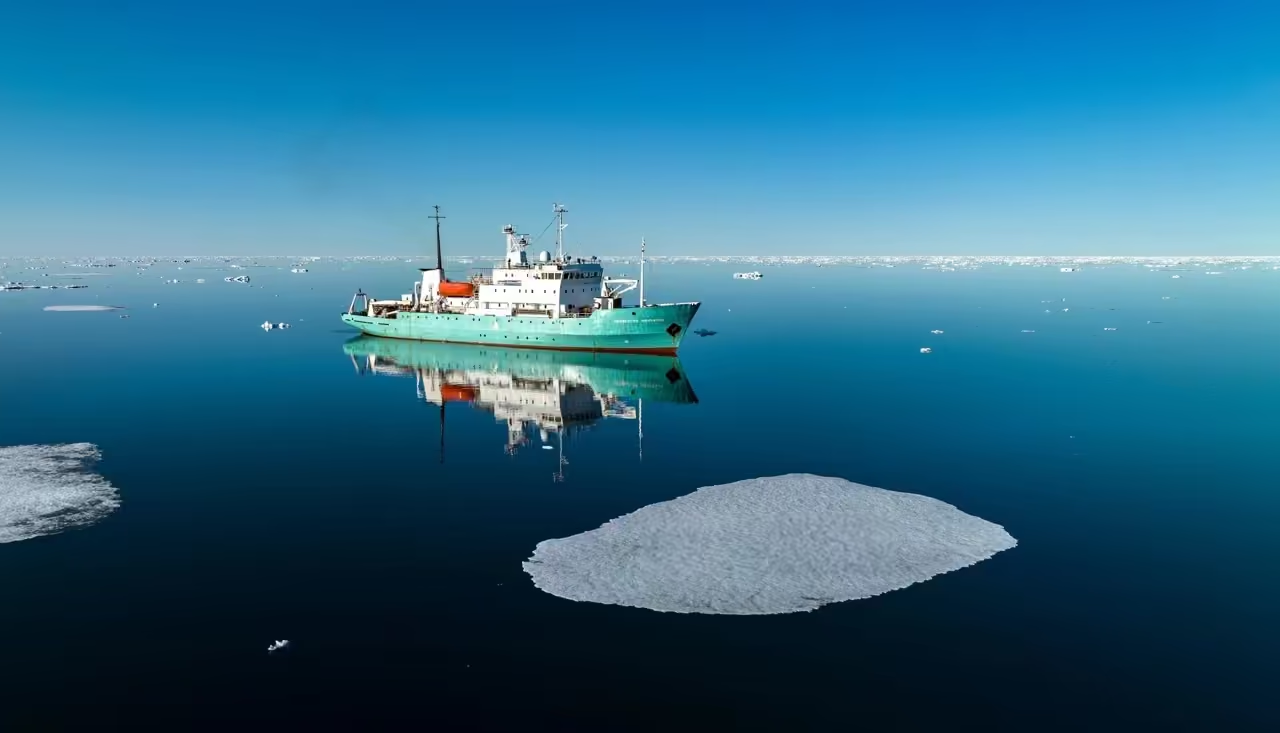
The expedition will be one of the first where the state of the sea surface will be simultaneously recorded by wave-measuring buoys, an unmanned aerial vehicle, and a shipborne radar. The scientists will compare the obtained results to assess the accuracy of each observation method in challenging Arctic conditions.
Scientists pay special attention to the impact of ice cover reduction. As the ice area decreases, the role of surface waves increases, becoming one of the factors in the destruction of sea ice. Longer and higher waves enhance the mechanical fragmentation of the ice cover, contribute to water mixing, and accelerate heat exchange.
An additional task will be to assess the effectiveness of wave-measuring buoys in high latitudes. Researchers expect to find out how much strong magnetic inclination affects the accuracy of navigation measurements, which are widely used in such devices.
The twentieth voyage of the scientific and educational expedition "Arctic Floating University" will take place from July 1 to July 22, 2026, on the research vessel "Professor Molchanov". The project remains the only Russian expedition that annually conducts comprehensive research in the Franz Josef Land area and the northern part of Novaya Zemlya at the beginning of the Arctic summer, forming a unique long-term observation database.
Read more on the topic:
Never miss our newsAdd this site to your preferred sources to see us more oftenAdd on Google

















