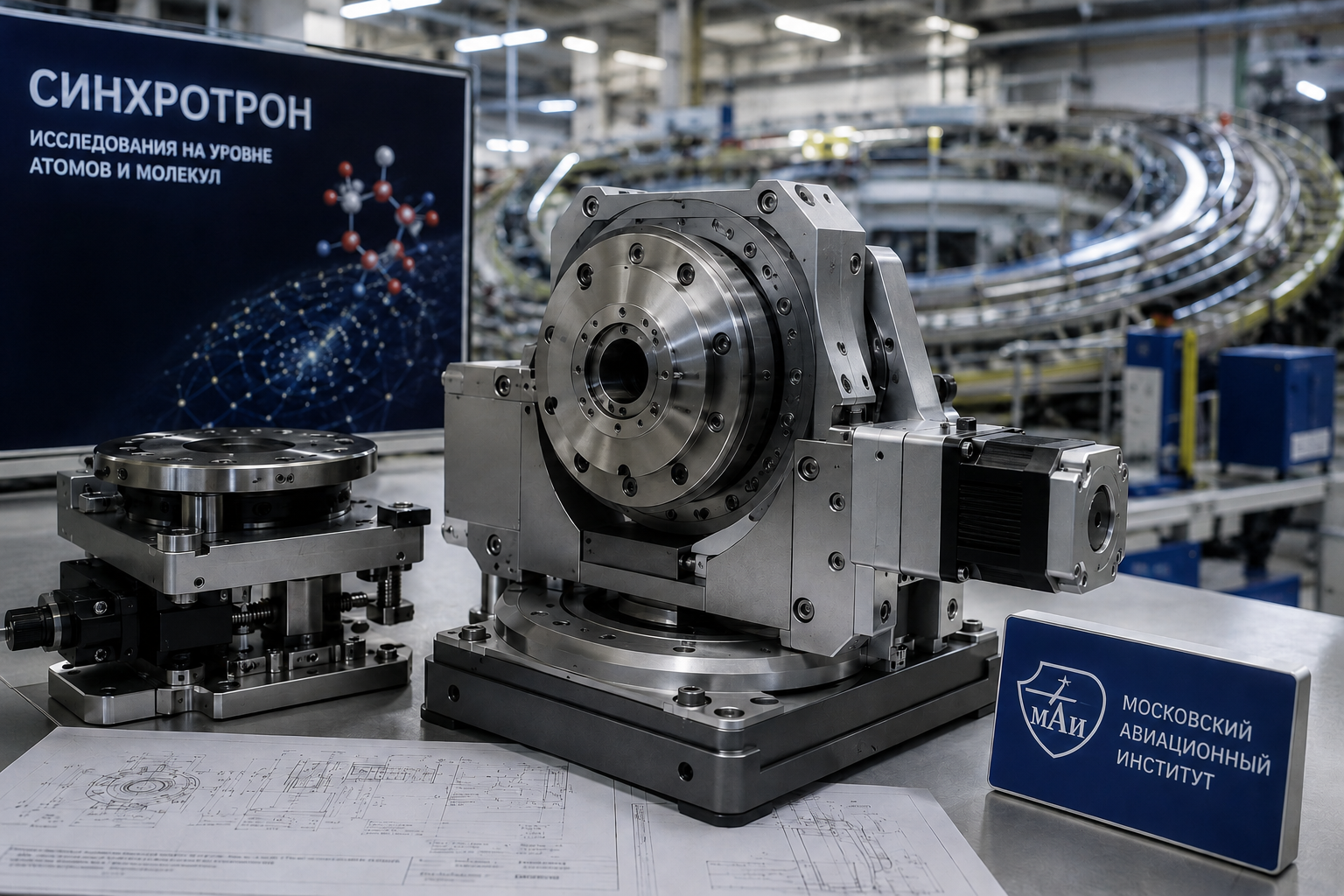
Scientists from MAI have created prototypes of mechanisms that help to direct the beam more precisely in new-generation synchrotrons. Such devices are needed to tune the optics inside scientific facilities. The university reported that the development should replace imported mechanisms in Russian synchrotrons.
A synchrotron is a large scientific facility that generates powerful X-ray radiation and allows the study of materials, proteins, and viruses at the atomic and molecular level. Fourth-generation facilities are already operating in France, Sweden, Brazil, and the USA. They can also be used to develop new materials for energy and create pharmaceutical drugs.
The new mechanisms created at MAI are intended for monochromators – devices that select a beam with the desired energy from the total radiation flux inside the synchrotron. For such a beam to be precise and stable, the optics inside the device must be tuned with almost no error – up to tenths of an arcsecond.
The prototypes are already ready. Their testing is planned to be completed in June. In the future, serial production of units for synchrotron stations used in Russia is envisioned.
The project is being implemented by the Institute of Robotics and Intelligent Systems of MAI and the OOO "Pimek" plant, commissioned by the Kurchatov Institute. The Kurchatov Institute is considered Russia's leading scientific organization in the field of synchrotron and neutron research.
Read more on the topic:
Never miss our newsAdd this site to your preferred sources to see us more oftenAdd on Google

















