Russian medical institutions have begun testing new absorbable hemostatic sponges QuikMed S, designed to stop massive bleeding. The development by the Kalashnikov Concern is already being tested in hospitals across Russia.
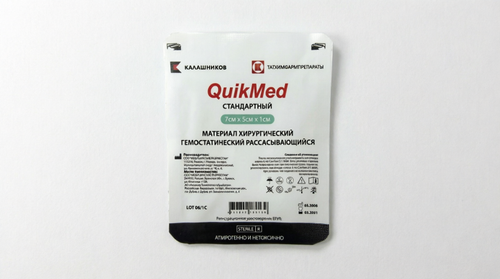
The new medical material was created as a domestic alternative to foreign hemostatic products. According to the developers, the cost of QuikMed S is 2–2.5 times lower than imported analogues, while production is entirely based on Russian technologies and raw materials.
The sponges are intended for use by medical specialists in severe internal organ injuries, including the liver, spleen, kidneys, lungs, and brain. After use, the material gradually dissolves in the body, requiring no additional removal.
Kalashnikov notes that the Russian market for hemostatic agents is still largely dependent on foreign supplies: about 90% of effective sponges are of imported origin. The new development should reduce dependence on external manufacturers and ensure stable supplies for hospitals.
Vasily Khudoleev, Director of the Medical Development Division at Kalashnikov Concern, reported that the production technology for QuikMed S has been fully developed, and the enterprise's capacities allow for large-scale production and organization of supplies throughout Russia.
Hemostatic sponges are developed based on two types of materials – a collagen-peptide matrix and oxidized regenerated cellulose. The first option activates platelets, concentrates blood cells and clotting factors due to its porous structure, and also promotes tissue regeneration.
The material based on oxidized regenerated cellulose ensures rapid absorption of blood and plasma, creates conditions for stopping bleeding, and has bactericidal properties. In addition, such a sponge can be divided into parts of the required size and shape directly during use.
Read more on the topic:
Never miss our newsAdd this site to your preferred sources to see us more oftenAdd on Google