A balancing two-wheeled robot controlled by artificial intelligence (AI) has been created at the Research Institute of Mechanics of Moscow State University named after M. V. Lomonosov. This was announced by Anton Rogachev, leading engineer of the laboratory of general mechanics of the institute, at the Congress of Young Scientists in Sirius.
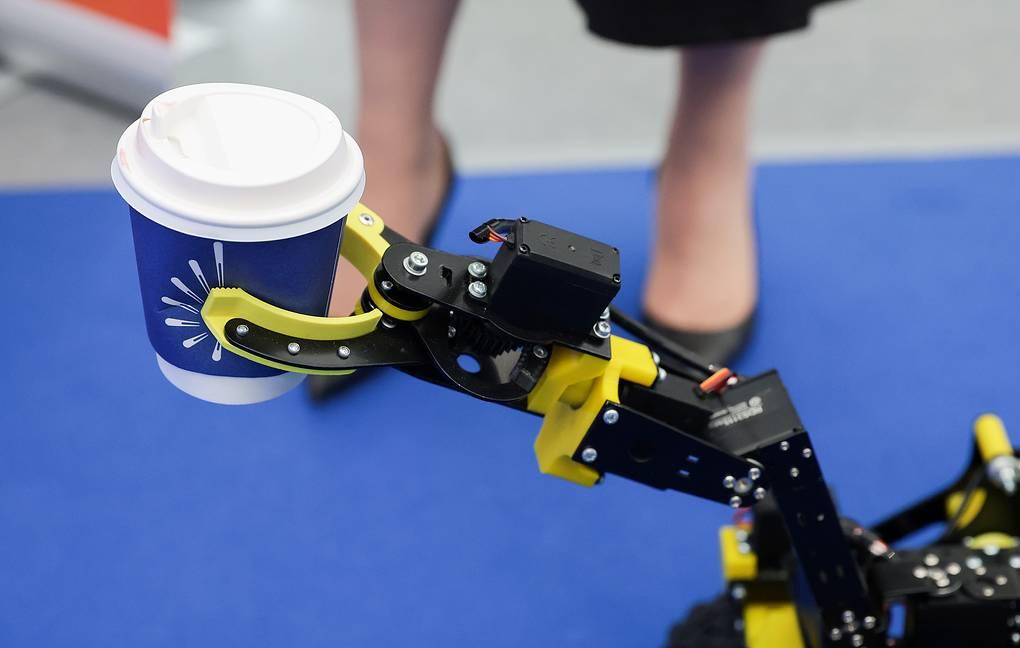
Unlike four-wheeled platforms, our development requires less space for maneuvering, while remaining stable and capable of moving loads weighing up to 60 kg. In the future, it may become the basis for creating a new generation of robot couriers, supervisors, and waiters using artificial intelligence (AI) algorithms.
The speed of the new robot will reach 20-25 km/h. It is planned to be used as an AI courier or waiter. The developer also emphasized the need to create special conditions for the operation of such robots.
Stability is a key parameter of such systems: robots should not fall when they encounter an obstacle or someone pushes them. In our experiments, we are trying to create such situations using heavy objects.
Scientists continue to test various sensors and algorithms to improve the model.
Earlier, www1.ru reported that a Russian robot manipulator has been created for laboratory work in chemistry and physics.
Read more on the topic:
"Battle of Robots-2024": Russian teams became champions
Rosatom will produce up to 3 thousand robots per year
Robots will toil: Russian industry will have 85 thousand robots by 2030
Never miss our newsAdd this site to your preferred sources to see us more oftenAdd on Google